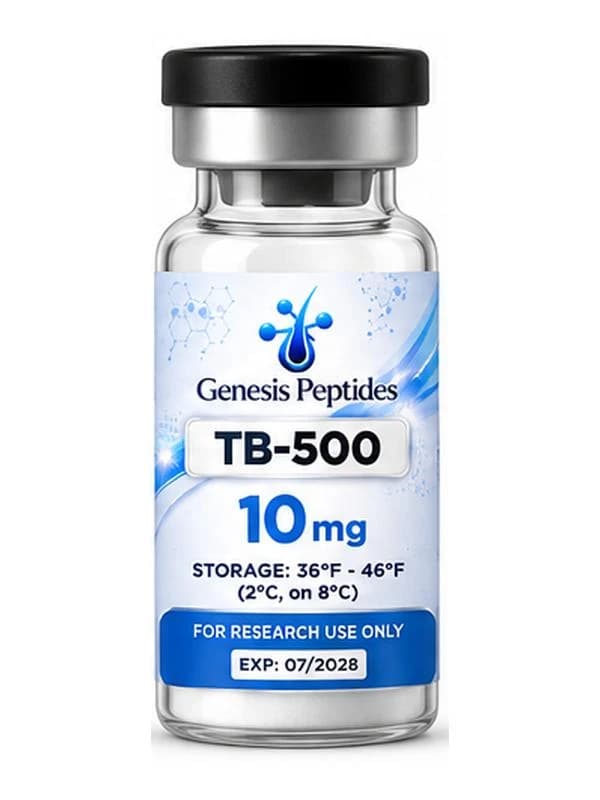
TB 500 Peptide 10mg Research Vial for Laboratory Use
For laboratory research use only. Not for human or veterinary use, not a medicine, food supplement or cosmetic.
- Batch-tested Certificate of analysis for every lot
- Research use only For laboratory research
- UK stock Dispatched from the UK
- Delivery from £6.05 Free over £100.00. Delivery policy
Research PeptidesResearch compound
Genesis Peptide TB-500 10mg Research Vial
Genesis Peptides supplies TB 500 peptide as a 10mg lyophilised (freeze-dried) research vial, dispatched from the UK.
- HPLC and mass spectrometry
- Research use only
£29.99no VAT charged
In stockUK stock, dispatched from the UK
- Strength
- 10mg
- Product
- TB 500 peptide, lyophilised powder
- Amount per vial
- 10mg
- Identity
- Mass spectrometry, batch-specific
- Appearance
- White to off-white lyophilised powder
- Storage
- −20 °C for long-term storage, protected from light and moisture
[INSERT MY APPROVED RESEARCH-USE WORDING]
Product Details and Specifications for This Research Peptide
| Product | TB 500 peptide, lyophilised powder |
|---|---|
| Amount per vial | 10mg |
| Form supplied | [CONFIRM from COA: full-length synthetic thymosin beta-4 (43 aa) OR Ac-LKKTETQ fragment (7 aa)] |
| Sequence | Full-length: Ac-SDKPDMAEIEKFDKSKLKKTETQEKNPLPSKETIEQEKQAGES Fragment: Ac-Leu-Lys-Lys-Thr-Glu-Thr-Gln (Ac-LKKTETQ) |
| Molecular formula | Full-length: C212H350N56O78S · Fragment: C38H68N10O14 |
| Molecular weight | Full-length: about 4,963.5 g/mol · Fragment: about 889.0 g/mol |
| Amount in moles | Full-length: about 2.0 µmol per 10mg · Fragment: about 11.2 µmol per 10mg |
| CAS number | Full-length Tβ4: 77591-33-4 [VERIFY] · Fragment: 885340-08-9 |
| Salt form | [acetate: CONFIRM from COA] |
| Purity (HPLC) | [≥ __% : CONFIRM batch figure] |
| Identity | Mass spectrometry, batch-specific |
| Appearance | White to off-white lyophilised powder |
| Vial | [__ml glass vial, rubber stopper, aluminium crimp cap: CONFIRM] |
| Testing lab | [Lab name, independent or in-house: CONFIRM] |
| Storage | −20 °C for long-term storage, protected from light and moisture |
The vial contains only the peptide as a dry powder, with no water or solvent added. Because the two forms of TB500 peptides differ so much in size, 10mg of the fragment contains about five and a half times as many molecules as 10mg of full-length thymosin beta-4. Researchers planning molar concentrations need to know which one is in the vial, so the form is stated on the label and the COA. The label also carries the batch number, which links to the certificate for that batch.
What Is TB 500 and How Does It Relate to Thymosin Beta 4?
What is TB-500? It is a name used by research-peptide and veterinary suppliers for synthetic peptides based on thymosin beta-4 (Tβ4). Tβ4 is a small natural protein of 43 amino acids, coded by the TMSB4X gene on the X chromosome. It is present in nearly all human and animal cells and is especially abundant in blood platelets and white blood cells.
Tβ4 was first isolated from calf thymus tissue by Allan Goldstein’s group, which published its full amino acid sequence in 1981 (Low et al., PNAS) [VERIFY]. The “thymosin” name comes from that thymus origin, although later work showed Tβ4 is made throughout the body and is not a thymus hormone. Its best-known job is inside the cell: it binds single actin molecules and holds them in reserve, which helps control how cells build and reshape their internal scaffold.
So, whats TB500 in one line? A lab-made version of thymosin beta-4, or of its actin-binding region, studied in cell and animal research and not approved as a medicine anywhere.
Is TB 500 the Same as Thymosin Beta 4 or a Fragment of It?
It depends on the supplier, and that is the most important thing to check before you use any TB500 peptide. The name is used for two different molecules:
- Full-length synthetic Tβ4: all 43 amino acids, with the acetyl group on the first serine that the natural protein carries. Chemically the same as natural thymosin beta-4.
- The Ac-LKKTETQ fragment: seven amino acids (positions 17 to 23 of Tβ4) with an acetyl group added to the start. This stretch is the central part of Tβ4’s actin-binding site. When an anti-doping lab in Belgium analysed a product sold as “TB-500” in 2012, this acetylated fragment is what they found in it (Esposito et al., Drug Test Anal, 2012).
Both are sold as TB500 peptides, but they are not interchangeable. The fragment is about one-sixth the size and contains only the actin-binding region, so published results on full-length Tβ4 do not automatically apply to it. This vial contains [full-length Tβ4 / Ac-LKKTETQ fragment: CONFIRM], and the mass spectrometry result on the COA confirms which.
Amino Acid Sequence, Molecular Weight and Chemical Structure
Full-length thymosin beta-4 (43 amino acids, N-terminal acetyl):
Ac-SDKPDMAEIEKFDKSKLKKTETQEKNPLPSKETIEQEKQAGES
- Molecular formula: C212H350N56O78S
- Molecular weight: about 4,963.5 g/mol
- Structure: a linear chain with no disulfide bridges. In water it is largely unstructured and only partly folds into a helix when it binds actin. It is rich in lysine (K) and glutamic acid (E), and has one methionine at position 6, which can oxidise in storage.
- Other named regions: the first four amino acids, Ac-SDKP, are released naturally as a separate tetrapeptide that is studied on its own.
TB-500 fragment (7 amino acids, N-terminal acetyl):
Ac-Leu-Lys-Lys-Thr-Glu-Thr-Gln (Ac-LKKTETQ)
- Molecular formula: C38H68N10O14
- Molecular weight: about 889.0 g/mol
- Structure: a short linear peptide with two lysines (positive) and one glutamic acid (negative). It has no methionine.
How Is TB 500 Studied in Laboratory Research?
Almost all published research uses full-length thymosin beta-4 in cells and animals, with a smaller number of studies on the actin-binding fragment. When people ask what is TB 500 used for in research, the answer covers three linked areas: how cells move, how new blood vessels form, and how tissue repairs in wound and injury models. The findings below come from those studies. They are not evidence of any effect in people.
Actin Binding and Cell Migration Research
How does TB-500 work at the molecular level? Tβ4 is the main protein that binds G-actin (single actin units) in many cell types. In 1991, Safer and colleagues showed that Tβ4 is the same molecule as “Fx”, a previously described actin-sequestering factor in platelets (J Biol Chem) [VERIFY]. By holding actin units in reserve, Tβ4 helps set how quickly cells can build the actin filaments they need to change shape and move.
Because cell movement depends on actin, Tβ4 became a tool for studying cell migration. In 1997 it was shown to stimulate directional migration of human endothelial cells in culture (Malinda et al., FASEB J) [VERIFY]. The LKKTETQ region is the core of that actin-binding site, which is why it was chosen as the short form sold as TB-500.
Blood Vessel and Angiogenesis Research
Researchers asking what does TB500 do to blood vessels have mostly studied angiogenesis, the growth of new vessels. Tβ4 was found to be switched on in endothelial cells as they formed vessel-like tubes in culture, and it promoted vessel growth in several models. A 2003 study tested the short actin-binding region on its own and found that it reproduced Tβ4’s effects on endothelial cell migration and vessel formation in those assays (Philp et al., FASEB J, 2003) [VERIFY].
In heart research, a 2004 mouse study reported that Tβ4 activated integrin-linked kinase, increased heart cell migration and survival, and improved heart function after an induced heart attack (Bock-Marquette et al., Nature, 2004) [VERIFY]. Later studies looked at whether it mobilises progenitor cells in the outer layer of the heart. These remain animal findings.
Wound Healing and Tissue Repair in Cell and Animal Models
So what does TB-500 do in wound models? In a 1999 rat study, Tβ4 given either on the skin or by injection increased re-epithelialisation (new skin covering the wound), wound contraction and collagen deposition in full-thickness wounds compared with untreated controls (Malinda et al., J Invest Dermatol) [VERIFY]. Similar work followed in corneal injury, skin and muscle models, summarised in a 2005 review describing Tβ4 as an actin-binding protein that “moonlights” in tissue repair (Goldstein et al., Trends Mol Med) [VERIFY].
Much less is published on the fragment itself. Laboratory and animal studies have looked at how Ac-LKKTETQ is broken down, mainly so anti-doping labs can detect it (Ho et al., J Chromatogr A, 2012).
What Does Current Evidence Say About Human Studies?
There are no published human trials of the TB 500 peptide fragment. Human studies have only used full-length thymosin beta-4, made by drug developers, and none has led to an approved medicine:
- Safety studies: a phase 1 study of intravenous Tβ4 in healthy volunteers was run in the US (NCT00743769), and a first-in-human phase 1 study of recombinant Tβ4 was carried out in healthy volunteers in China [VERIFY details].
- Wound studies: small phase 2 trials tested a Tβ4 gel in slow-healing skin ulcers and in epidermolysis bullosa [VERIFY].
- Eye studies: a Tβ4 eye drop (RGN-259) has been tested in dry eye and in neurotrophic keratopathy. The European phase 3 SEER-3 trial missed its primary endpoint in June 2025, and the US phase 3 SEER-2 trial (NCT05555589) was still under way at that time [VERIFY current status].
Tβ4 levels have also been studied as a marker in some cancers, which is one reason long-term safety is an open research question [VERIFY]. Animal results often do not carry over to people, so none of the findings on this page should be read as evidence of safety or effect in humans.
TB 500 vs BPC 157: What Is the Difference in Research?
Searches for BPC 157 vs TB500 are common because the two are often sold side by side, but they are unrelated molecules with different origins and research histories.
| TB-500 | BPC-157 | |
|---|---|---|
| Origin | Synthetic thymosin beta-4, a protein found in almost all cells, or its actin-binding fragment | Partial sequence of a protein isolated from human gastric juice |
| Length | 43 amino acids (full Tβ4) or 7 (Ac-LKKTETQ) | 15 amino acids |
| Molecular weight | about 4,963.5 g/mol (full) or 889.0 g/mol (fragment) | about 1,419.5 g/mol |
| Main research focus | Actin binding, cell migration, angiogenesis, wound and heart models | Gut models, blood vessel growth, nitric oxide signalling, tendon cells |
| Human data | Phase 1–3 trials of full-length Tβ4 only; none of the fragment | A few small uncontrolled reports |
| WADA status | Prohibited, S2.3 (growth factors) | Prohibited, S0 (non-approved substances) |
Some researchers study the two together to see whether different pathways give a different result from either peptide alone. For a combined BPC 157 & TB 500 product, see our [LINK: BPC-157 + TB-500 Wolverine nasal spray] and [LINK: Wolverine stack pen]. For single BPC-157, see [LINK: BPC-157 vial]. Both BPC-157 TB-500 blends and single vials carry the same research-use-only terms.
Certificate of Analysis and Purity Testing for Each Batch
Every batch of our TB 500 peptide comes with a certificate of analysis (COA) from [CONFIRM: lab name] [independent third-party lab: CONFIRM]. The COA shows two separate tests: HPLC, which measures purity, and mass spectrometry, which confirms the molecule and, for TB-500, tells you whether it is full-length Tβ4 or the fragment. Both are needed. A high purity figure alone does not prove the main peak is the right peptide, and a correct mass alone does not show how much of the sample is impurity.
How to Find and Download the Certificate for Your Batch
- Find the batch number on your vial label [and on the packing slip: CONFIRM].
- Go to [LINK: COA library page], or use the COA link in the product images on this page.
- Choose the certificate whose batch number matches your vial and download the PDF.
- If you cannot find your batch, contact us at [CONFIRM: email] and we will send it.
A batch-matched COA is the simplest way to judge any TB-500 UK supplier: a certificate that does not match your batch number tells you nothing about what is in your vial.
How to Read HPLC Purity and Mass Spectrometry Results
- HPLC purity: the trace shows one main peak for the peptide and smaller peaks for impurities, such as shortened or oxidised versions. Purity is the main peak’s area as a percentage of all peaks. This batch: [CONFIRM: __%].
- Mass spectrometry: the measured mass should match the expected mass for the form supplied. For the fragment, that is about 889 (seen as about 890 for [M+H]+ or about 445.5 for [M+2H]2+). For full-length Tβ4 it is about 4,963.5, usually shown as several multiply charged ions, for example about 993.7 for [M+5H]5+ or about 1,241.9 for [M+4H]4+. A clear match confirms identity and tells you which TB500 peptide you have.
- Net peptide content (if shown): the share of the powder that is peptide, as opposed to counter-ions (usually acetate) and residual water. It is usually below 100% even when purity is high.
- Check the details: the product name, form, batch number, test date and lab name should all be on the certificate.
How to Store and Handle a Lyophilised Peptide Vial
Freeze-dried TB-500 is much more stable as a dry powder than in solution. For long-term storage, keep the sealed vial at −20 °C, away from light and moisture. For short periods, 2–8 °C in a fridge is generally suitable for lyophilised peptides [CONFIRM in-house guidance]. Before opening a cold vial, let it reach room temperature so moisture from the air does not condense on the powder. If the vial contains full-length Tβ4, keep air exposure to a minimum, because its single methionine can oxidise; the fragment has no methionine. Handle with gloves, using sterile technique, in a lab setting.
Storage Before and After Reconstitution
- Before reconstitution: sealed vial at −20 °C long term, or 2–8 °C short term. Unopened shelf life: [__ months: CONFIRM].
- Reconstitution: in research protocols, the powder is usually dissolved in sterile bacteriostatic water [LINK: bac water], added slowly down the side of the vial and swirled gently rather than shaken.
- After reconstitution: store the TB500 peptide solution at 2–8 °C, protected from light, and use within [__ days/weeks: CONFIRM from your stability data]. Avoid repeated freezing and thawing; if longer storage is needed, split the solution into single-use aliquots and freeze them.
- Discard any solution that turns cloudy, changes colour or contains particles.
Is Research Use of This Peptide Legal in the UK, and Is It Banned in Sport?
[LEGAL REVIEW: this section]
- Not a licensed medicine. TB-500 and thymosin beta-4 have no marketing authorisation from the MHRA, so they cannot legally be sold or supplied in the UK as medicines for human use. Genesis Peptides sells TB-500 UK stock only as a research chemical for laboratory use.
- Not a controlled drug. TB-500 is not listed under the Misuse of Drugs Act 1971 [VERIFY].
- Not approved anywhere. The TB-500 FDA approval status is unapproved: there is no FDA approval for TB-500 or thymosin beta-4 for any use, and Australia’s Sport Integrity agency states that thymosin beta-4 is not approved for human use anywhere in the world.
- Banned in sport. Is TB500 banned? Yes. Thymosin beta-4 and its derivatives, including TB-500, are on the World Anti-Doping Agency (WADA) Prohibited List under S2.3, growth factors and growth factor modulators, and are prohibited at all times, in and out of competition. UK Anti-Doping (UKAD) applies the same list. In 2016 the Court of Arbitration for Sport banned 34 current and former Essendon AFL players over a thymosin beta-4 programme [VERIFY]. TB-500 is also tested for in horse racing.
We will not sell to anyone who says they intend to use the product on a person or an animal.
What to Check Before Buying Research Peptides in the UK
If you plan to buy TB500, the right product is the one whose quality and identity you can check, not the cheapest. Before you buy TB-500 from any supplier, check:
- Which molecule it is. The listing and COA should say whether it is full-length thymosin beta-4 or the Ac-LKKTETQ fragment. A supplier that cannot tell you is a red flag.
- A batch-matched COA with both HPLC purity and mass spectrometry identity, from a named lab.
- Net peptide content and salt form, so you know how much actual peptide is in the vial.
- Clear research-use labelling and no dosing, injection or health claims. A supplier that gives human dosing advice is selling outside the rules.
- A UK address and contact details, and dispatch from the UK.
- Correct format: lyophilised powder in a sealed vial.
Many TB500 buy searches lead to marketplaces and resellers that cannot show a batch certificate. To buy TB 500 UK stock from Genesis, add the 10mg vial to your basket at the top of this page.
UK Delivery, Dispatch and Packaging
- Dispatch: orders placed before [CONFIRM: time] on a working day are dispatched the same day from [CONFIRM: town/county].
- Delivery: [CONFIRM: carrier and service, e.g. Royal Mail Tracked 24], [CONFIRM: price / free over £__].
- Packaging: vials are sealed and packed in [CONFIRM: protective packaging details], in plain outer packaging. Lyophilised peptides are stable at room temperature for the length of normal UK transit; store them as described above on arrival [CONFIRM].
- Payment: [CONFIRM: payment methods].
When you buy TB500 UK stock from us, each order includes the batch number for COA lookup. For larger TB-500 UK orders for a lab, contact [CONFIRM: email].
Scientific References and Published Studies
Key published studies on thymosin beta-4 and TB-500 cited on this page:
- Low TL, Hu SK, Goldstein AL. Complete amino acid sequence of bovine thymosin β4: a thymic hormone that induces terminal deoxynucleotidyl transferase activity in thymocyte populations. Proc Natl Acad Sci USA. 1981;78(2):1162–1166. [VERIFY]
- Safer D, Elzinga M, Nachmias VT. Thymosin β4 and Fx, an actin-sequestering peptide, are indistinguishable. J Biol Chem. 1991;266(7):4029–4032. [VERIFY]
- Malinda KM, Goldstein AL, Kleinman HK. Thymosin β4 stimulates directional migration of human umbilical vein endothelial cells. FASEB J. 1997;11(6):474–481. [VERIFY]
- Malinda KM, Sidhu GS, Mani H, et al. Thymosin β4 accelerates wound healing. J Invest Dermatol. 1999;113(3):364–368. [VERIFY]
- Philp D, Huff T, Gho YS, Hannappel E, Kleinman HK. The actin binding site on thymosin β4 promotes angiogenesis. FASEB J. 2003;17(14):2103–2105. [VERIFY]
- Bock-Marquette I, Saxena A, White MD, DiMaio JM, Srivastava D. Thymosin β4 activates integrin-linked kinase and promotes cardiac cell migration, survival and cardiac repair. Nature. 2004;432(7016):466–472. [VERIFY]
- Goldstein AL, Hannappel E, Kleinman HK. Thymosin β4: actin-sequestering protein moonlights to repair injured tissues. Trends Mol Med. 2005;11(9):421–429. [VERIFY]
- Esposito S, Deventer K, Goeman J, Van der Eycken J, Van Eenoo P. Synthesis and characterization of the N-terminal acetylated 17–23 fragment of thymosin beta 4 identified in TB-500, a product suspected to possess doping potential. Drug Test Anal. 2012;4(9):733–738.
- Ho EN, Kwok WH, Lau MY, et al. Doping control analysis of TB-500, a synthetic version of an active region of thymosin β4, in equine urine and plasma by liquid chromatography–mass spectrometry. J Chromatogr A. 2012;1265:57–69.
- ClinicalTrials.gov: NCT00743769 (phase 1, intravenous Tβ4 in healthy volunteers); NCT05555589 (SEER-2, RGN-259 in neurotrophic keratopathy).
- World Anti-Doping Agency. Prohibited List, S2.3 Growth Factors and Growth Factor Modulators (current year).
[CHECK: add DOI or PubMed links before publishing]
FAQ
Frequently Asked Questions
Quick answers on batch testing, delivery and ordering. Can’t find what you need? Our team is happy to help.
Contact UsWhat is inside a TB 500 vial?
Only lyophilised peptide powder: 10mg of [CONFIRM: full-length thymosin beta-4 / the Ac-LKKTETQ fragment] as its [CONFIRM: acetate] salt, with no water, solvent or other active ingredients. The exact purity and net peptide content of each TB 500 peptide vial are on the batch COA.
Is TB 500 the same as thymosin beta 4?
Not always. Some TB500 peptide products are full-length synthetic thymosin beta-4 (43 amino acids), and others are only its 7-amino-acid actin-binding fragment, Ac-LKKTETQ. The mass spectrometry result on the COA shows which one you have: about 4,963.5 for full-length Tβ4, about 889 for the fragment.
Are there any human studies on thymosin beta 4?
Yes, but only on full-length Tβ4 developed as a drug: phase 1 safety studies in healthy volunteers, small phase 2 wound studies, and phase 2 and 3 eye-drop trials. The European phase 3 SEER-3 trial missed its main goal in 2025. No product has been approved, and there are no published human trials of the TB-500 fragment.
Is TB 500 legal to buy in the UK?
Buying TB-500 UK stock as a research chemical for laboratory use is lawful [LEGAL REVIEW]. It is not a licensed medicine and must not be sold or used as one. Is TB500 banned in sport? Yes, under WADA’s S2.3 category, at all times.
Is this product third party tested?
Yes. Every batch of this TB 500 peptide is tested by [CONFIRM: lab name] [CONFIRM independent] for HPLC purity and mass spectrometry identity, and the batch certificate is available to download.
How long can it be stored once reconstituted?
Keep reconstituted TB-500 at 2–8 °C, away from light, and use it within [__ days/weeks: CONFIRM]. For longer storage, freeze single-use aliquots and avoid repeated freeze-thaw cycles. Unopened lyophilised vials last much longer at −20 °C. All products are for laboratory research use only. Not for human or veterinary use.
Calculator
Peptide Reconstitution Calculator
Enter the amount in the vial, the volume of diluent added and the amount you need. The calculator works out the concentration and the volume to measure.
- Volume to measure
- 0.05 ml
- 50 µl
- Concentration
- 5,000 mcg/ml
- 5 mg/ml
- Portions per vial
- 40
- at 250 mcg each