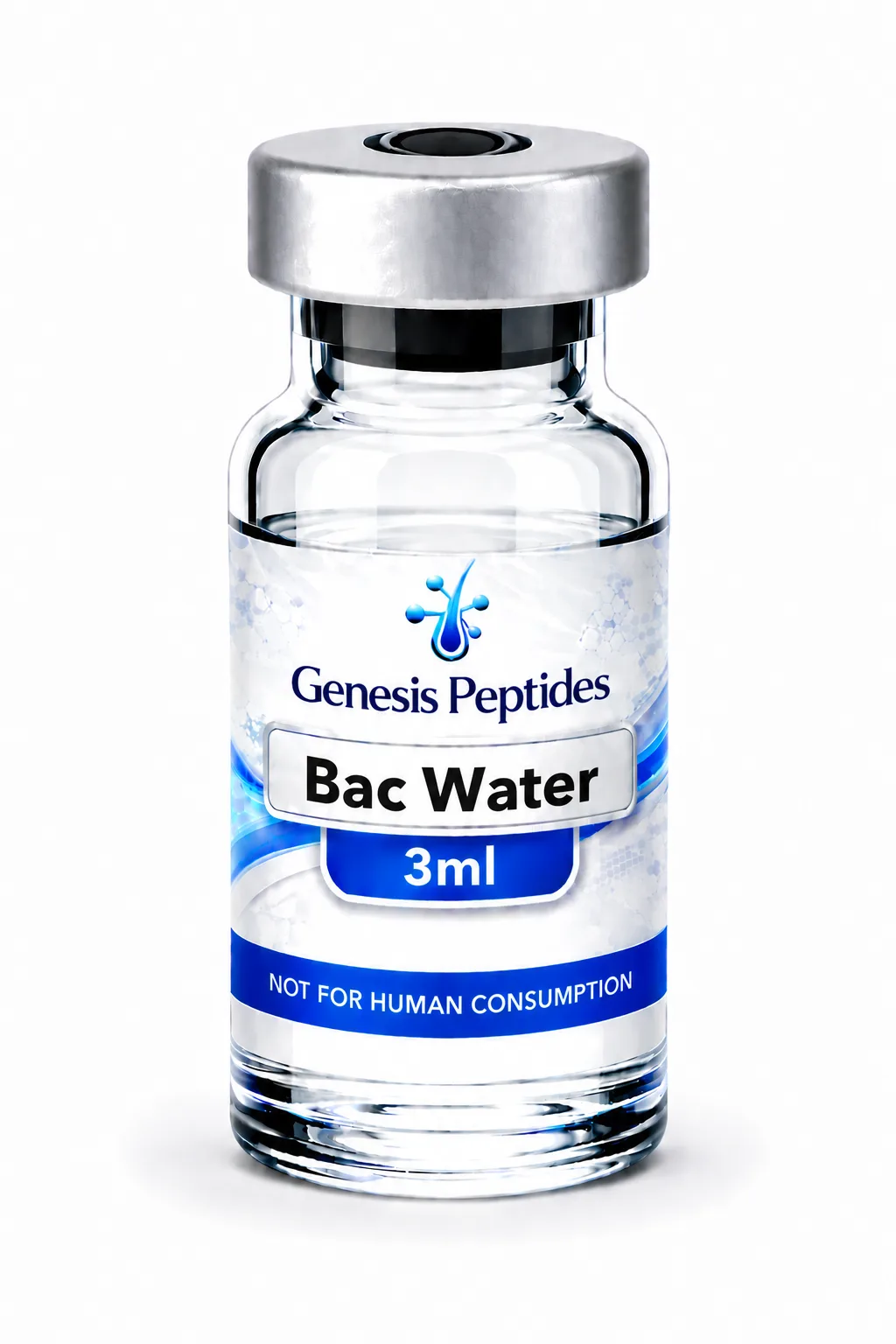
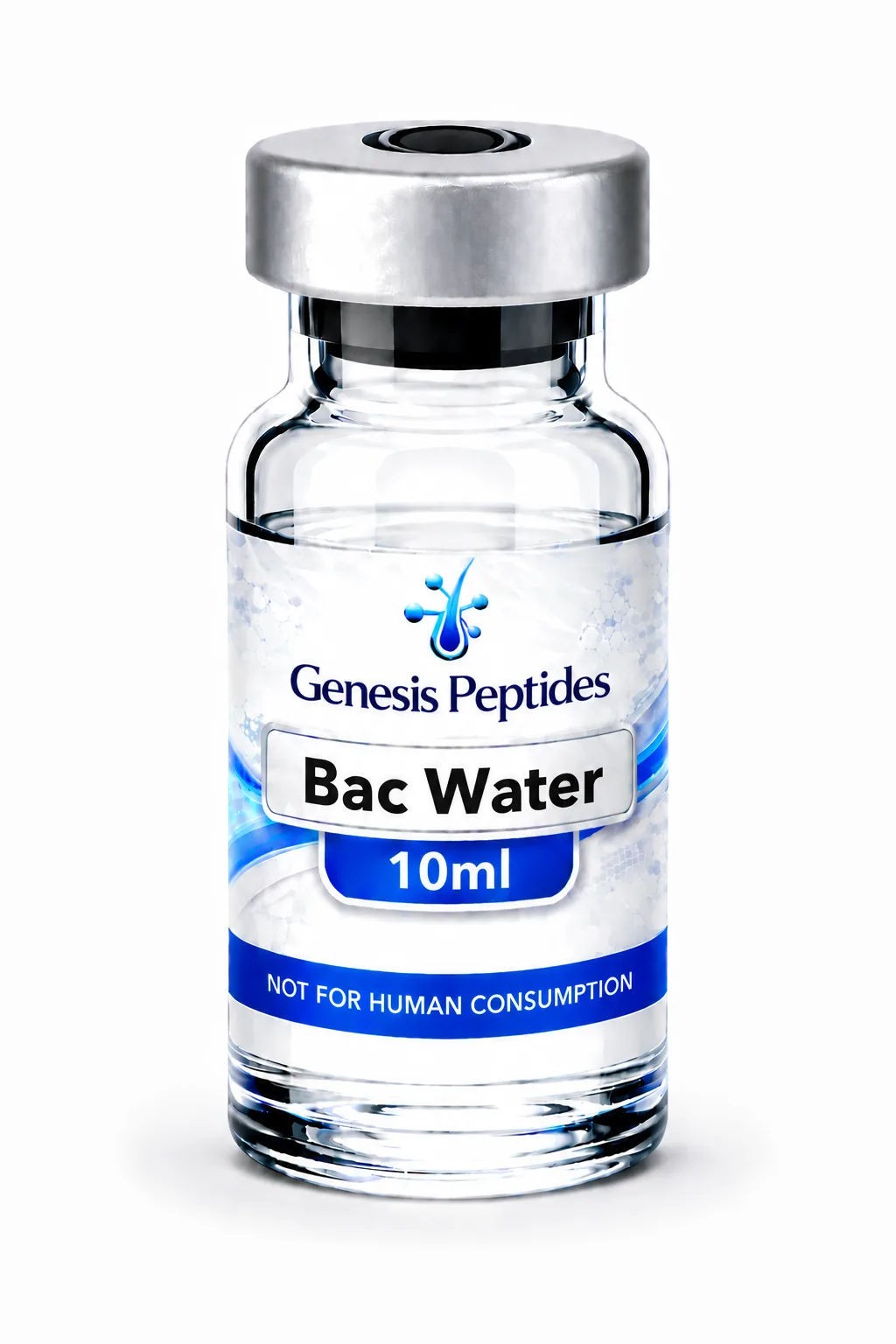
Buy Bacteriostatic Water 10ml in the UK: Lab-Tested, COA Included, Fast Dispatch
For laboratory research use only. Not for human or veterinary use.
- Batch-tested Certificate of analysis for every lot
- Research use only For laboratory research
- UK stock Dispatched from the UK
- Delivery from £6.05 Free over £100.00. Delivery policy
Reconstitution SuppliesResearch compound
Bacteriostatic Water 10ml
Genesis Peptides supplies bac water in sealed 10ml multi-dose vials for reconstituting lyophilised research peptides. Each vial holds sterile water with 0.9% benzyl alcohol, and every batch comes with a Certificate of Analysis (COA).
- HPLC and mass spectrometry
- Research use only
£5.99no VAT charged
In stockUK stock, dispatched from the UK
- Strength
- 10ml
- Contents
- Sterile water with 0.9% benzyl alcohol
- Volume
- 10ml
- Storage (unopened)
- Room temperature, 20–25°C, away from direct light and heat
[INSERT MY APPROVED RESEARCH-USE WORDING]
Bacteriostatic Water 10ml for Peptide Reconstitution: Quick Product Overview
10ml bac water is the size most researchers reach for. It holds enough to reconstitute several standard peptide vials, and its preservative lets you draw from the same vial more than once within its 28-day in-use period. Our bacteriostatic water 10ml vials are sealed, labelled with a batch number and expiry date, and backed by a batch COA.
What You Get in Each Sterile 10ml Bacteriostatic Water Vial
So what is in bac water? Just two ingredients: sterile water and 0.9% benzyl alcohol (9 mg per ml) as a preservative. Each order includes:
- One 10ml glass vial sealed with a rubber stopper, aluminium crimp and flip-off cap
- Batch (lot) number and expiry date printed on the label
- A Certificate of Analysis for that batch, [ADD: “included in the box” or “downloadable from this page”]
- Safety Data Sheet (SDS) available [ADD: link or “on request”]
Vial Size, Concentration and Key Specifications at a Glance
| Volume | 10ml |
|---|---|
| Contents | Sterile water with 0.9% benzyl alcohol |
| Preservative concentration | 9 mg benzyl alcohol per ml |
| Container | Multi-dose glass vial, rubber stopper, crimp seal [CONFIRM: glass type and cap colour] |
| pH | [ADD: value from your COA; the USP range is 4.5 to 7.0] |
| Storage (unopened) | Room temperature, 20–25°C, away from direct light and heat |
| In-use period after first puncture | Up to 28 days, unless the label states otherwise |
| Documentation | Batch COA and SDS |
| Intended use | Laboratory research use only |
Hospira vs generic bac water: the best-known brand is Hospira bacteriostatic water, made by Hospira, a Pfizer company, and usually supplied in 30ml multi-dose vials. Its formula is the same as ours: sterile water with 0.9% benzyl alcohol. The brand on the label matters less than what the batch tests show, so compare the COA (sterility, endotoxin, benzyl alcohol content and pH) whichever supplier you use. Genesis Peptides is not affiliated with Hospira or Pfizer.
What Is Bacteriostatic Water and What Is It Used for in Peptide Research?
What’s bac water? Bac water, short for bacteriostatic water, is sterile water with 0.9% benzyl alcohol added. “Bacteriostatic” means it stops bacteria from multiplying. It does not kill every organism already present, so it does not replace clean technique, but it slows contamination when a vial’s stopper is punctured more than once.
As for what bac water is used for: in research, it is a reconstitution solution. It turns a freeze-dried (lyophilised) peptide powder into a liquid at a known concentration so it can be measured accurately.
Bacteriostatic Water vs Sterile Water: What Is the Difference?
Both start as sterile water. The difference is the preservative:
- Bacteriostatic water contains 0.9% benzyl alcohol and comes in a multi-dose vial. You can puncture the stopper several times and keep the vial for up to 28 days after first use.
- Sterile water (sterile water for injection) has no preservative and is single-use. Once opened, any unused water should be thrown away.
On bac water vs sterile water for peptides: bac water is the usual choice for a peptide you will sample from repeatedly. Sterile water suits single-use preparations, or experiments where benzyl alcohol could interfere.
What Does 0.9% Benzyl Alcohol Do in a Bacteriostatic Water Vial?
Benzyl alcohol is a widely used pharmaceutical preservative. At 0.9% (9 mg per ml) it inhibits the growth of most bacteria that may be introduced each time a needle passes through the stopper. That is what makes the vial safe to keep and reuse within its in-use period. It does not sterilise the contents, so the stopper should still be wiped with 70% isopropyl alcohol before every puncture.
People sometimes search for making bac water themselves. Mixing benzyl alcohol into water outside a sterile manufacturing process can’t guarantee sterility, an exact 0.9% concentration or freedom from endotoxins, and you have no COA to check. A tested, sealed vial removes those unknowns.
Why Do Researchers Use Bacteriostatic Water to Reconstitute Peptides?
There are four main reasons to choose bacteriostatic water for peptides:
- Repeat sampling: most peptide vials are drawn from over days or weeks, and the preservative protects the solution between uses.
- Compatibility: many research peptides dissolve readily in water, so no special solvent is needed.
- Accuracy: dissolving a known peptide mass in a measured volume gives a known concentration.
- Stability: a cold, preserved solution generally keeps longer than one made with unpreserved water.
That is what bac water is for with peptides: a clean, preserved base that keeps a reconstituted vial usable for repeat laboratory work.
Purity, Third-Party Testing and Certificates of Analysis (COA) Explained
For research you need to know exactly what is in the vial. That is why each batch of our bacteriostatic water comes with documentation you can check against the label.
Why Every Batch of Bacteriostatic Water Is Third-Party Tested with a COA
A Certificate of Analysis records the results of bacteriostatic water testing for one specific production batch. Independent testing gives you a result that doesn’t rely only on the manufacturer’s word. [ADD: name of testing lab and which tests are run, e.g. sterility, endotoxin, benzyl alcohol content, pH] Match the lot number on your vial to the lot number on the COA.
How to Read the Certificate of Analysis for Bacteriostatic Water
A typical COA for bacteriostatic water includes:
- Product name and lot number: must match the label on your vial.
- Manufacture and expiry dates.
- Appearance: clear, colourless solution, free from visible particles.
- Benzyl alcohol content: close to 0.9% (9 mg/ml), within the stated tolerance.
- pH: within the specified range (the USP range is 4.5 to 7.0).
- Sterility: “pass” or “no growth”, often to the USP <71> method.
- Bacterial endotoxins: below the stated limit, often to the USP <85> method.
- Particulate matter and fill volume.
- Signature and date from the testing laboratory.
Where to Find the Safety Data Sheet (SDS) and Handling Information
The SDS describes the product’s composition, hazards, safe handling, storage, spill response and disposal. You can [ADD: “download it from this page” or “request it from support@…”]. UK laboratories should keep the SDS with their COSHH assessment for the product.
What ISO-Certified Manufacturing Means for Batch Consistency
ISO certification means the manufacturer works under an audited quality management system. ISO 9001 covers quality management in general, and ISO 13485 is the equivalent standard for medical device manufacturing. In practice this means documented procedures, traceable batches and regular audits, so each vial is made the same way as the last. [ADD: which ISO standard the manufacturer holds, and certificate number if you can publish it. Remove this section if you can’t confirm it.]
How to Reconstitute Lyophilised Peptides with Bacteriostatic Water Step by Step
Reconstitution means adding a measured volume of bac water to a vial of freeze-dried peptide and letting it dissolve. The aim is a clear, fully dissolved solution with as little stress on the peptide as possible. The same method applies to most water-soluble research peptides.
Step-by-Step Peptide Reconstitution Guide for Laboratory Use
- Let the peptide vial and the bacteriostatic water reach room temperature. This stops condensation forming inside a cold vial.
- Check both vials: seals intact, labels and batch numbers readable, bac water clear and free of particles.
- Flip off the caps and wipe both rubber stoppers with a 70% isopropyl alcohol swab. Let them air-dry.
- Using a new sterile syringe and needle, draw up the planned volume of bac water.
- Insert the needle into the peptide vial and let the water run slowly down the inside wall of the glass.
- Swirl or roll the vial gently until the powder has fully dissolved. Do not shake.
- Label the vial with the date, the volume added and the resulting concentration, then refrigerate at 2–8°C.
How to Prepare a Clean Work Area and Sterile Equipment First
Work on a clean, uncluttered surface wiped down with disinfectant, ideally in a laminar flow hood if one is available. Wash your hands and wear nitrile gloves. Lay out everything first: the peptide vial, the bacteriostatic water, alcohol swabs, a new sealed syringe and needle, a sharps container and a pen for labelling. Never reuse syringes or needles between vials.
How to Add Bacteriostatic Water Slowly to Protect the Peptide
Peptides are fragile molecules. Spraying water directly onto the powder can cause foaming and local stress that may damage or clump the peptide. Angle the needle so the water runs down the inside wall of the vial, and push the plunger slowly. If the vial is under vacuum it may pull the water in by itself, so control the flow.
Why You Should Swirl Gently Instead of Shaking the Vial
Shaking creates bubbles and an air-to-liquid surface where peptide chains can unfold and stick together. Gently swirling or rolling the vial between your fingers dissolves most peptides within a minute or two. If some powder remains, leave the vial in the fridge for a few minutes and swirl again. The finished solution should be clear.
How Much Bacteriostatic Water Should You Add to a Peptide Vial?
There is no single correct volume. The amount of water does not change how much peptide is in the vial; it only sets the concentration. Most researchers add between 1ml and 3ml to a standard 5mg or 10mg vial, choosing a volume that gives a concentration that is easy to measure.
The formula is: concentration (mg/ml) = peptide in vial (mg) ÷ water added (ml).
| Bac water added | 5mg vial | 10mg vial |
|---|---|---|
| 1ml | 5 mg/ml | 10 mg/ml |
| 2ml | 2.5 mg/ml | 5 mg/ml |
| 3ml | 1.67 mg/ml | 3.33 mg/ml |
How to mix reta with bac water: retatrutide (“reta”) is an investigational peptide that is not approved as a medicine and is sold for research only. It is reconstituted the same way as other lyophilised peptides: follow the steps above, then use the formula to work out the concentration. For example, 2ml of bac water added to a 10mg vial gives 5 mg/ml. Always check the supplier’s datasheet for any peptide-specific instructions.
Work Out the Right Amount of Water with Our Free Peptide Reconstitution Calculator
Our free peptide reconstitution calculator does the maths for you. Enter the amount of peptide in the vial (mg) and the volume of bacteriostatic water you plan to add (ml), and it shows the concentration in mg/ml and in mcg per 0.1ml. It works for single peptides and blends. [ADD: link to calculator page]
The calculator works out concentrations for laboratory measurement. It does not give dosing advice.
How Long Does Bacteriostatic Water Last After Opening, and How Should You Store It?
How long does bac water last? An unopened vial lasts until the expiry date on its label. Once the stopper has been punctured, the standard guidance (USP General Chapter <797> for multi-dose containers) is to use it within 28 days, unless the manufacturer states a different period. Write the date of first use on the vial so you know when to throw it away.
Does bacteriostatic water expire if unopened? Yes. Every vial carries an expiry date, and it should not be used after that date even if it has never been opened.
How to Store Bacteriostatic Water Correctly at Home or in the Laboratory
Here is how to store bac water at each stage:
- Unopened: keep it at room temperature (20–25°C), upright, away from direct sunlight and heat. That is how to store bac water unopened; it does not need a fridge before first use.
- After opening: many labs move opened vials into a fridge at 2–8°C for an extra margin against growth. How long does bac water last in the fridge? Still 28 days from first puncture. Refrigeration does not extend that limit.
- Do not freeze bacteriostatic water. Freezing can crack the vial or damage the seal.
- Keep the cap area clean and swab the stopper before each use.
Good bacteriostatic water storage comes down to three things: the right temperature, a clean stopper and a dated label.
How Long Do Reconstituted Peptides Stay Stable in Bacteriostatic Water?
Stability depends on the specific peptide, so check its datasheet first. As a general rule:
- Lyophilised (powder) peptides are the most stable form. Store them at −20°C long term, or 2–8°C for shorter periods.
- Once reconstituted, keep the solution at 2–8°C and protected from light. Many research peptides stay usable for several weeks this way, but it varies by peptide.
- Avoid repeated freezing and thawing, which can break down the peptide. To keep it longer, split it into single-use portions before freezing.
- Never keep a reconstituted vial longer than the 28-day in-use period of the bac water used to make it.
Signs of Contamination or Spoilage to Look For Before Every Use
Inspect the bac water vial, and any reconstituted peptide vial, against a light and a dark background before each use. If anything below applies, do not use it.
Cloudiness, Floating Particles and Colour Changes in the Vial
Bacteriostatic water should be completely clear and colourless. Cloudiness, haze, visible particles, strands or any colour tint can mean microbial growth or contamination. In a reconstituted peptide, cloudiness can also mean the peptide has not dissolved properly or has clumped.
A Damaged Seal, Loose Cap or Broken Tamper Ring
On arrival, the flip-off cap and aluminium crimp should be intact and the stopper should sit firmly. A missing cap, a loose or dented crimp, a cracked vial or a stopper that has been punctured before first use means sterility cannot be guaranteed. Do not use the vial; contact us with your order number and a photo. [ADD: contact email or form link]
Precautions, Safety Information and Research-Use-Only Notice for UK Buyers
This product is sold for laboratory research only. Please read the precautions below and the SDS before handling.
What Does For Laboratory Research Use Only, Not for Human Consumption Mean?
It means the product is supplied for laboratory experiments and must not be injected, swallowed or otherwise used in humans or animals. It is not a licensed medicine. Genesis Peptides does not give advice on human use, and orders may be refused if we believe a product is intended for that purpose. By ordering, you confirm you are buying for legitimate research.
How to Handle and Dispose of Used Vials Safely in the Laboratory
- Put used needles and syringes straight into an approved sharps container. Never recap needles.
- Dispose of sharps containers and empty or expired vials through your institution’s clinical or chemical waste route, in line with local rules.
- Small spills of bac water can be wiped up with absorbent material; see the SDS for details.
- Don’t pour unused peptide solutions down the drain unless your waste procedure allows it.
Which Peptides Need a Different Diluent Instead of Bacteriostatic Water?
Most water-soluble research peptides can be reconstituted with bac water, but not all. Always check the peptide’s datasheet first. The main exceptions:
- Acetic acid vs bac water: some peptides, such as IGF-1 LR3, are usually dissolved in dilute acetic acid (for example 0.6%) because they are more soluble and stable in an acidic solution. Bac water is close to neutral, so it is the wrong choice for these.
- Very hydrophobic peptides: these may need a small amount of an organic solvent such as DMSO before dilution.
- Experiments sensitive to preservatives: benzyl alcohol can affect some cell-culture and assay work, so sterile water or a buffer is used instead.
Which Size of Bacteriostatic Water Should You Buy for Your Research?
Choose a size by how much water you will use within 28 days of opening, not by how much you might use eventually. Anything left after 28 days should be discarded, so a vial that is too big leads to waste. Common sizes are:
| Size | Reconstitutes (at 2ml per vial) | Best for |
|---|---|---|
| 2ml bacteriostatic water | 1 vial | A single peptide vial, no leftover |
| 3ml bac water | 1 vial (with spare) | One-off reconstitution with room for a 3ml volume |
| 10ml bacteriostatic water | Up to 5 vials | Regular research with several peptides a month |
| Bacteriostatic water 30ml | Up to 15 vials | High-volume labs that will use it within 28 days |
| Bacteriostatic water 100ml | Up to 50 vials | Large labs only; most of it will expire otherwise |
[ADD: which of these sizes Genesis Peptides sells, with links]
When a 10ml Bacteriostatic Water Vial Is Enough for Everyday Reconstitution
If you add 2ml per peptide vial, one 10ml vial reconstitutes up to five vials, or three at 3ml each. For most researchers working with a handful of peptides a month, 10ml is the right balance: enough for a typical batch, with little left over at the 28-day mark.
Buying Bacteriostatic Water in Bulk for Repeat Research Use in the UK
If you reconstitute regularly, several sealed 10ml vials are usually better value than one large vial. Each unopened vial keeps until its printed expiry date, and the 28-day clock only starts when you open the next one. To purchase bacteriostatic water in multi-packs and buy bacteriostatic water in the UK at a lower price per vial, see [ADD: multi-pack options and bulk pricing, e.g. 3, 5 or 10 vials].
Why Buy Bacteriostatic Water from Genesis Peptides as Your UK Research Supplier?
If you are wondering where to buy bacteriostatic water in the UK, or where can I buy bac water with proper batch documentation, look for three things: a COA for every batch, a UK dispatch address, and clear storage and handling information. [ADD: 1–2 sentences on what makes Genesis Peptides the best place to buy bac water, using only claims you can back up, such as years trading or orders shipped.]
Same-Day UK Dispatch on Eligible Orders and Fast Delivery Times
Orders placed before [ADD: cut-off time, e.g. 2pm] on [ADD: working days] are dispatched the same day. For bacteriostatic water next day delivery, choose [ADD: service, e.g. Royal Mail Tracked 24] at checkout. Other options: [ADD: services, usual delivery times and prices].
Discreet and Protective Packaging That Keeps Vials Safe in Transit
Vials are packed upright in protective inserts to prevent breakage, inside plain outer packaging with no product names on the outside. [CONFIRM: packaging actually used]
Returns and Money-Back Guarantee in Line with UK Consumer Law
Under the Consumer Contracts Regulations 2013, consumers buying online normally have 14 days from delivery to cancel. That right does not cover sealed goods that are unsuitable for return for health or hygiene reasons once the seal is broken, so opened vials can’t be returned for a change of mind. If an item arrives damaged or faulty, the Consumer Rights Act 2015 gives you the right to a refund, repair or replacement. [ADD: your returns window, how to start a return, and any guarantee beyond the legal minimum]
How to Track Your Order Online from Dispatch to Delivery
When your order is dispatched, you receive an email with a tracking number and a link to follow it with the courier. You can also check your order status by logging into your account. [CONFIRM: email and account tracking both exist]
Complete Your Order with Related Reconstitution Supplies and Research Peptides
Most bac water orders go out alongside a peptide and the supplies to prepare it. Add what you need in one order.
Research Peptides That Are Commonly Reconstituted with Bacteriostatic Water
- BPC-157 [CONFIRM: link]
- TB-500 [CONFIRM: link]
- BPC-157 + TB-500 blend [CONFIRM: link]
- Retatrutide [CONFIRM: link, if sold]
- [ADD: other peptides you sell that dissolve in bac water, e.g. GHK-Cu]
Peptide Pens and Other Reconstitution Supplies from Genesis Peptides
- Peptide pens [CONFIRM: link; confirm the product exists]
- Sterile syringes and needles [CONFIRM: if sold]
- 70% isopropyl alcohol swabs [CONFIRM: if sold]
- Sharps containers [CONFIRM: if sold]
Sources, References and Further Reading on Peptide Reconstitution
- Bacteriostatic Water for Injection, USP, product information (Pfizer/Hospira): pfizermedicalinformation.com
- Bacteriostatic Water for Injection, USP, label via DailyMed, U.S. National Library of Medicine: dailymed.nlm.nih.gov
- USP General Chapter <797> Pharmaceutical Compounding: Sterile Preparations (in-use time for multiple-dose containers): usp.org
- The Consumer Contracts (Information, Cancellation and Additional Charges) Regulations 2013: legislation.gov.uk
- Consumer Rights Act 2015: legislation.gov.uk
- Health and Safety Executive, Control of Substances Hazardous to Health (COSHH): hse.gov.uk
- [ADD: your own COA and SDS links]
FAQ
Frequently Asked Questions
Quick answers on batch testing, delivery and ordering. Can’t find what you need? Our team is happy to help.
Contact UsIs Bacteriostatic Water the Same as Sterile Water?
No. Both are sterile, but bacteriostatic water contains 0.9% benzyl alcohol as a preservative and can be used for up to 28 days after first puncture. Sterile water has no preservative and is single-use.
How Many Millilitres of Bacteriostatic Water Do I Need for One Peptide Vial?
Usually 1ml to 3ml for a 5mg or 10mg vial. The volume only sets the concentration: for example, 2ml in a 5mg vial gives 2.5 mg/ml. Use our reconstitution calculator to check other combinations.
Can I Reuse the Same Bacteriostatic Water Vial More Than Once?
Yes. It is a multi-dose vial, so you can draw from it several times. Use a new sterile needle every time, swab the stopper first, and discard the vial 28 days after the first puncture.
Does Bacteriostatic Water Need to Be Kept in the Fridge?
Does bac water need to be refrigerated before opening? No. Store unopened vials at room temperature (20–25°C). After opening, many labs refrigerate at 2–8°C, but the 28-day limit still applies. Reconstituted peptides should always be kept in the fridge. Don’t freeze bacteriostatic water.
Can I Use Bacteriostatic Water with BPC-157, TB-500 and Other Peptides?
Yes. BPC-157 and TB-500 are water-soluble and are routinely reconstituted with bacteriostatic water in research settings. Some peptides need a different diluent such as dilute acetic acid, so check the datasheet for anything else.
How Fast Is UK Delivery for Bacteriostatic Water Orders?
When you order bacteriostatic water before [ADD: cut-off] on a working day, it ships the same day, and UK delivery usually takes [ADD: 1–2 working days] with tracking.
Can I Download the COA for My Batch Before I Order?
[ADD: “Yes, the COA for the current batch is on this page” or “Yes, email us and we’ll send it”.] The lot number on the COA matches the lot number printed on the vial you receive.
Calculator
Peptide Reconstitution Calculator
Enter the amount in the vial, the volume of diluent added and the amount you need. The calculator works out the concentration and the volume to measure.
- Volume to measure
- 0.1 ml
- 100 µl
- Concentration
- 2,500 mcg/ml
- 2.5 mg/ml
- Portions per vial
- 20
- at 250 mcg each