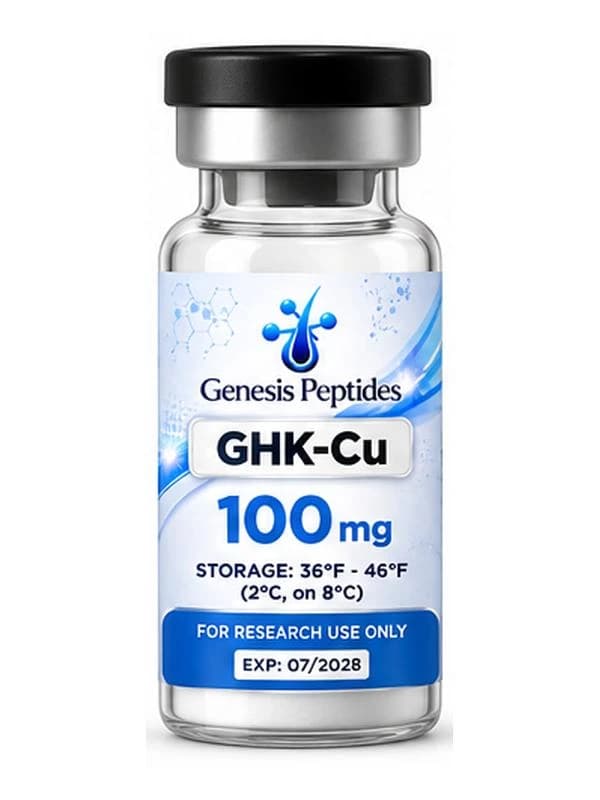
GHK Cu 100mg Research Peptide for Laboratory Use
For laboratory research use only. Not for human or veterinary use, not a medicine, cosmetic or food supplement.
- Batch-tested Certificate of analysis for every lot
- Research use only For laboratory research
- UK stock Dispatched from the UK
- Delivery from £6.05 Free over £100.00. Delivery policy
Research PeptidesResearch compound
Genesis Peptide GHK-Cu 100mg Research Vial
Genesis Peptides supplies GHK Cu as a 100mg lyophilised (freeze-dried) research vial, dispatched from the UK. GHK-Cu is the copper complex of GHK, a three-amino-acid peptide (glycine, histidine, lysine) first found in human blood plasma in 1973.
- HPLC and mass spectrometry
- Research use only
£29.99no VAT charged
In stockUK stock, dispatched from the UK
- Strength
- 100mg
- Product
- GHK Cu (copper tripeptide-1), lyophilised powder
- Amount per vial
- 100mg
- Identity
- Mass spectrometry, batch-specific
- Appearance
- Blue to violet-blue lyophilised powder
- Storage
- −20 °C for long-term storage, protected from light and moisture
[INSERT MY APPROVED RESEARCH-USE WORDING]
Product Details and Specifications for This Research Peptide
| Product | GHK Cu (copper tripeptide-1), lyophilised powder |
|---|---|
| Amount per vial | 100mg |
| Other names | GHK-Cu, GHKCu, copper GHK, copper tripeptide-1, prezatide copper, glycyl-L-histidyl-L-lysine copper(II) |
| Sequence | H-Gly-His-Lys-OH (GHK), bound to one copper(II) ion |
| Molecular formula | C14H22CuN6O4 (copper complex); GHK alone C14H24N6O4 |
| Molecular weight | About 401.9 g/mol (complex); GHK alone about 340.4 g/mol |
| Amount in moles | About 249 µmol per 100mg (complex, before salt and water) |
| CAS number | 89030-95-5 (GHK-Cu); 49557-75-7 (GHK) |
| Salt form | [acetate, chloride or free complex: CONFIRM from COA] |
| Purity (HPLC) | [≥ __% : CONFIRM batch figure] |
| Identity | Mass spectrometry, batch-specific |
| Appearance | Blue to violet-blue lyophilised powder |
| Vial | [__ml glass vial, rubber stopper, aluminium crimp cap: CONFIRM] |
| Testing lab | [Lab name, independent or in-house: CONFIRM] |
| Storage | −20 °C for long-term storage, protected from light and moisture |
Each vial of GHK Cu peptide contains only the peptide–copper complex as a dry powder, with no water, solvent or filler. It is a blue copper peptide lyophilized powder: the blue comes from the copper itself, not from any dye. The label carries the batch number, which links to the certificate for that batch.
What Is GHK Cu and Why Is It Called a Copper Peptide?
What is GHK-Cu? It is a small peptide, GHK, with a copper ion tightly attached. GHK stands for its three amino acids in one-letter code: G for glycine, H for histidine and K for lysine. Loren Pickart and Martin Thaler first reported the GHK peptide in human plasma in 1973, while studying why blood from younger people affected liver cells differently from blood from older people. Its sequence was confirmed as glycyl-L-histidyl-L-lysine in 1977 [VERIFY: Schlesinger, Pickart and Thaler, Experientia, 1977].
It is called a copper peptide because GHK binds copper(II) very strongly, and in the body much of it is thought to carry copper. GHK is found naturally in plasma, saliva and urine. Plasma levels have been reported at about 200 ng/ml at age 20, falling to about 80 ng/ml by age 60. So what is GHK Cu peptide in a vial? It is a synthetic copy of that complex, made by peptide synthesis and then combined with copper. If you are looking for the copper peptide name on ingredient lists or in papers, you will see it as copper tripeptide-1, prezatide copper, or simply GHK-Cu.
Is It the Same as GHKCU, Copper Tripeptide or Copper Free GHK?
- GHKCu: yes, the same molecule. “GHKCu”, “GHK-Cu” and “GHK Cu” are just different ways of writing it, and searches for peptides GHKCu find the same compound.
- Copper tripeptide: usually yes. “Copper tripeptide-1” is the name GHK-Cu is given in cosmetic ingredient lists (its INCI name). Be careful with the general phrase “copper tripeptide”, because other three-amino-acid copper complexes exist.
- Copper free GHK: no. GHK on its own (CAS 49557-75-7) is the bare peptide without copper. It is a white or colourless powder rather than blue, and it has a different mass. In a solution or culture medium that contains copper, free GHK will pick some up, so researchers who compare the two forms usually control copper levels carefully.
- AHK-Cu: a different peptide. The AHK-Cu peptide has alanine in place of glycine (Ala-His-Lys) and also binds copper. On AHK-Cu vs GHK-Cu: they are related but not interchangeable, and a COA for one does not cover the other. Searches for AHK Cu peptide or AHKCu peptide refer to that separate compound.
- Biotinyl GHK: also different. Biotinyl GHK is GHK with a biotin group attached to the N-terminus and usually no copper; it is used as a cosmetic ingredient and is not the same molecule.
Amino Acid Sequence, Molecular Weight and Chemical Structure
H-Gly-His-Lys-OH (GHK) · Cu(II)
- Molecular formula: C14H22CuN6O4 for the 1:1 GHK Cu copper peptide complex. GHK alone is C14H24N6O4; when copper binds, two hydrogens are lost.
- Molecular weight: about 401.9 g/mol for the complex and about 340.4 g/mol for GHK alone.
- CAS numbers: 89030-95-5 for GHK-Cu, 49557-75-7 for GHK.
- How the copper is held: the copper(II) ion is gripped by three nitrogen atoms from the peptide: the free amino group of glycine, the nitrogen of the glycine–histidine peptide bond, and a nitrogen in the ring of histidine. A fourth position is taken by water or by an oxygen or nitrogen from a neighbouring molecule. In crystals, this gives a square-pyramid arrangement around the copper.
- Lysine: the long, positively charged lysine side chain does not hold the copper. It is thought to help the complex interact with cell surfaces and other molecules.
- Solubility: the complex dissolves readily in water.
Why Does the Powder Look Blue and Can the Colour Change Between Batches?
The blue is a property of the copper. A copper(II) ion held by nitrogen atoms in this way absorbs light at around 605 nm, in the orange-red part of the spectrum, so the light that is left looks blue. It is the same reason copper sulphate solution is blue. GHK without copper is white.
Yes, the shade can vary between batches, from a lighter sky blue to a deeper blue or violet-blue, and this is normal. Common reasons are:
- Copper-to-peptide ratio: with a slight excess of peptide, some copper is held by two GHK molecules at once, which shifts the colour towards violet.
- Salt form and moisture: different counter-ions (such as acetate or chloride) and small differences in residual water change the shade of the solid.
- The freeze-dried cake: a fluffy, porous cake scatters more light and looks paler than a dense one, even when the chemistry is identical.
- Amount and vial: 100mg of powder looks darker than a small amount, and glass and lighting change how the colour appears.
What is not normal: a white or colourless powder (it may be GHK without copper), or a green, brown or grey colour, clumping, or a solution that is cloudy. Check these against the appearance line on the COA and contact us if they do not match.
How Is This Peptide Studied in Laboratory Research?
GHK Cu peptide has been studied for about fifty years, mostly in cell cultures, animal models and copper chemistry, and later in gene expression data. Much of the published literature comes from Loren Pickart and his co-authors, so it is worth reading alongside independent work. The findings below describe what has been reported in the laboratory. They are not evidence of any effect in people.
Copper Binding and Chemistry Research
A large part of GHK copper research is pure chemistry: how tightly the peptide binds copper, which atoms hold it, and how the bound copper behaves. X-ray crystallography and spectroscopy have mapped the binding site described above. Solution studies show that at pH 7.4 the main form is one copper per peptide, and that with extra peptide a two-peptide complex also forms (Bossak-Ahmad et al., Int J Mol Sci, 2020). Researchers also study how GHK exchanges copper with albumin, the main copper carrier in blood, and how binding changes copper’s redox behaviour, meaning how easily it gains or loses an electron [VERIFY: Hureau et al., Chem Eur J, 2011].
This is also where the copper gluconate vs copper peptide question has a chemical answer. Copper gluconate is a simple copper salt: the copper is loosely held and easily released. In GHK Cu copper the copper is held so tightly that very little is free in solution, which is why GHK-Cu and copper salts are used as separate controls in experiments.
Collagen and Extracellular Matrix Research
The extracellular matrix is the network of proteins, such as collagen and elastin, and sugar-based molecules called glycosaminoglycans that holds tissue together. In 1988, Maquart and colleagues reported that adding copper peptides GHK-Cu to cultures of fibroblasts (the cells that make connective tissue) increased collagen production [VERIFY: FEBS Lett, 1988]. The same group later reported more collagen and glycosaminoglycans in small wound chambers implanted in rats [VERIFY: J Clin Invest, 1993]. Other cell studies have looked at how copper GHK Cu affects the enzymes that break the matrix down (matrix metalloproteinases) and their natural inhibitors.
Skin Cell and Wound Healing Research in Cell and Animal Models
In cell models, copper GHK Cu peptide has been tested on fibroblasts and keratinocytes, measuring cell growth, movement in scratch assays and matrix production. In animal models, studies in rats, rabbits and other species have compared wound size and tissue structure in treated and untreated wounds. One study in rats with wounds made to have a poor blood supply reported smaller wounds after 13 days with GHK than with the gel alone or no treatment [VERIFY: Canapp et al., Vet Surg, 2003]. Good study designs include GHK without copper and a copper salt as controls, because a result could come from the peptide, the copper, or the complex. Reviews of copper peptides GHK collect these studies, but most are small and from a few groups (Pickart et al., Biomed Res Int, 2015).
Gene Expression Research
Newer work on the GHK peptide uses gene expression data. In 2012, researchers at Boston University compared gene activity in lung tissue from people with and without emphysema, then searched the Broad Institute’s Connectivity Map, a database of how cell lines respond to over a thousand compounds, for anything with the opposite pattern. GHK came out as a top match, and in follow-up tests it restored some features of normal function in fibroblasts taken from damaged lung tissue (Campbell et al., Genome Med, 2012) [VERIFY detail].
Pickart’s group has used the same database to report that peptide GHK-Cu is associated with expression changes in a large share of human genes [VERIFY figure before quoting a number] (Pickart and Margolina, Int J Mol Sci, 2018). These are analyses of existing data from cancer cell lines, not new experiments, so they suggest directions for research rather than proving an effect.
What Does Current Evidence Say About Human Studies?
Human evidence for copper peptide GHK-Cu is limited:
- Wound gel trials, 1990s: a gel made from GHK-Cu (Iamin, from ProCyte) showed promising results in an early diabetic foot ulcer study, but in a Phase III trial of 511 patients at 30 centres it was no better than placebo (reported October 1994). It was later cleared in the US only as a wound dressing, in 1996, not as a medicine.
- Cosmetic studies: small, short studies of creams containing copper tripeptide-1, many published in cosmetic journals or as conference reports rather than as large controlled trials.
- No approved medicine: GHK-Cu is not an approved medicine in the UK, the EU or the US [VERIFY on ClinicalTrials.gov for current trials before publishing].
So, when people ask what is GHK Cu peptides research really based on, the answer is mostly cell, animal and chemistry work. None of the findings on this page should be read as evidence of safety or effect in humans.
Certificate of Analysis and Purity Testing for Each Batch
Every batch of GHK Cu comes with a certificate of analysis (COA) from [CONFIRM: lab name] [independent third-party lab: CONFIRM]. The COA shows two separate tests: HPLC, which measures purity, and mass spectrometry, which confirms the molecule is GHK-Cu. Both are needed: a high purity figure alone does not prove the main peak is the right peptide, and a correct mass alone does not show how much impurity is present.
How to Find and Download the Certificate for Your Batch
- Find the batch number on your vial label [and on the packing slip: CONFIRM].
- Go to [LINK: COA library page], or use the COA link in the product images on this page.
- Choose the certificate whose batch number matches your vial and download the PDF.
- If you cannot find your batch, contact us at [CONFIRM: email] and we will send it.
A batch-matched COA is the simplest way to judge any supplier of peptides GHK Cu: a certificate that does not match your batch number tells you nothing about what is in your vial.
How to Read HPLC Purity and Mass Spectrometry Results
- HPLC purity: the trace shows one main peak for the peptide and smaller peaks for impurities such as shortened or modified chains. Purity is the main peak’s area as a percentage of all peaks. This batch: [CONFIRM: __%]. A figure of exactly 100% is a warning sign, as real results almost never show it.
- Mass spectrometry: for GHK-Cu, the copper complex usually appears at about 402.1 (as [GHK + Cu − H]+), with a second peak about 2 units higher at roughly half its height, because natural copper is a mix of two isotopes (copper-63 and copper-65). That copper pattern is a useful identity check. Many labs also report GHK at about 341.2 ([M+H]+), since copper can be lost during the test [CONFIRM which your lab reports].
- Appearance: should say blue or violet-blue powder. “White” suggests GHK without copper.
- Net peptide content and copper content (if shown): how much of the powder is peptide and copper, as opposed to counter-ions and water. Net content is usually below 100% even when purity is high.
- Check the details: product name, batch number, test date and lab name should all be on the certificate.
How to Store and Handle a Lyophilised Peptide Vial
Freeze-dried GHK Cu peptide is much more stable as a dry powder than in solution. For long-term storage, keep the sealed vial at −20 °C, away from light and moisture. For short periods, 2–8 °C in a fridge is generally suitable for lyophilised peptides [CONFIRM in-house guidance]. Before opening a cold vial, let it reach room temperature so moisture from the air does not condense on the powder. Handle with gloves, using sterile technique, in a lab setting.
Storage Before and After Reconstitution
- Before reconstitution: sealed vial at −20 °C long term, or 2–8 °C short term. Unopened shelf life: [__ months: CONFIRM].
- Reconstitution: in research protocols the powder is usually dissolved in sterile water, bacteriostatic water [LINK: bac water] or a neutral buffer, added slowly down the side of the vial and swirled gently rather than shaken. It should give a clear blue solution. The volume depends on the concentration your experiment needs; for example, 100mg in 10ml gives 10mg/ml.
- Points specific to copper peptides GHK Cu: avoid acidic solutions, because low pH releases copper from the peptide. Avoid chelating agents such as EDTA, which pull the copper out, and reducing agents such as ascorbic acid, which change copper(II) to copper(I).
- After reconstitution: store the solution at 2–8 °C, protected from light, and use within [__ days/weeks: CONFIRM from your stability data]. For longer storage, split it into single-use aliquots and freeze them, avoiding repeated freezing and thawing.
- Discard any solution that turns green, brown or colourless, goes cloudy or contains particles.
Is Research Use of This Peptide Legal in the UK, and Is It Banned in Sport?
[LEGAL REVIEW: this section]
- Not a licensed medicine. GHK-Cu has no marketing authorisation from the MHRA, so it cannot legally be sold or supplied in the UK as a medicine for human use. Genesis Peptides sells GHK Cu only as a research chemical for laboratory use.
- Not a controlled drug. It is not listed under the Misuse of Drugs Act 1971 or the Psychoactive Substances Act 2016 [VERIFY].
- Not a cosmetic product. GHK-Cu is used as an ingredient in some cosmetics under the name copper tripeptide-1, and many copper peptides UK searches are for those creams and serums. A research vial is not a cosmetic: it has no cosmetic safety report or notification, and must not be applied to skin or hair.
- Sport. GHK-Cu is not named on the World Anti-Doping Agency (WADA) Prohibited List. However, the list’s S0 class bans, at all times, any pharmacological substance not covered elsewhere that has no current approval by a government health authority for human therapeutic use. Athletes subject to UK Anti-Doping (UKAD) rules should treat it as possibly prohibited and check with UKAD.
We will not sell to anyone who says they intend to use the product on a person or an animal.
What to Check Before Buying Research Peptides in the UK
If you plan to buy GHK copper peptide for laboratory work, the right product is the one whose quality and identity you can check, not the cheapest. Many listings that come up for peptides GHK Cu buy or copper peptide UK are skincare products, not research material. Before you buy from any supplier of peptides UK GHK Cu, check:
- A batch-matched COA with both HPLC purity and mass spectrometry identity, from a named lab.
- A blue product. A white “GHK-Cu” is not the copper complex.
- The right molecule. The mass should match GHK-Cu, not AHK-Cu or another copper peptide, and not a blend unless that is what you want.
- Net peptide content and salt form, so you know how much actual peptide is in the vial.
- Clear research-use labelling and no dosing, injection, skin or health claims.
- A UK address and contact details, and dispatch from the UK.
When comparing prices of GHKCu between suppliers, compare price per verified milligram, not per vial. Our price for the 100mg vial is [CONFIRM: £__]. To buy from Genesis, add the vial to your basket at the top of this page. Each order includes the batch number for COA lookup.
UK Delivery, Dispatch and Packaging
- Dispatch: orders placed before [CONFIRM: time] on a working day are dispatched the same day from [CONFIRM: town/county].
- Delivery: [CONFIRM: carrier and service, e.g. Royal Mail Tracked 24], [CONFIRM: price / free over £__].
- Packaging: vials are sealed and packed in [CONFIRM: protective packaging details], in plain outer packaging. Lyophilised peptides are stable at room temperature for the length of normal UK transit; store them as described above on arrival [CONFIRM].
- Payment: [CONFIRM: payment methods].
As a UK supplier of UK peptides GHK Cu, every GHK Cu vial on this page ships from UK stock. For larger lab orders, contact [CONFIRM: email].
Scientific References and Published Studies
Key studies on GHK Cu peptide cited on this page. Most can be found on PubMed by searching “GHK-Cu”, “copper peptide GHK-Cu” or “glycyl-L-histidyl-L-lysine”.
- Pickart L, Thaler MM. Tripeptide in human serum which prolongs survival of normal liver cells and stimulates growth in neoplastic liver. Nat New Biol. 1973;243(124):85–87.
- Schlesinger DH, Pickart L, Thaler MM. Growth-modulating serum tripeptide is glycyl-histidyl-lysine. Experientia. 1977;33(3):324–325. [VERIFY]
- Maquart FX, Pickart L, Laurent M, et al. Stimulation of collagen synthesis in fibroblast cultures by the tripeptide-copper complex glycyl-L-histidyl-L-lysine-Cu2+. FEBS Lett. 1988;238(2):343–346. [VERIFY]
- Maquart FX, Bellon G, Chaqour B, et al. In vivo stimulation of connective tissue accumulation by the tripeptide-copper complex glycyl-L-histidyl-L-lysine-Cu2+ in rat experimental wounds. J Clin Invest. 1993;92(5):2368–2376. [VERIFY]
- Canapp SO Jr, Farese JP, Schultz GS, et al. The effect of topical tripeptide-copper complex on healing of ischemic open wounds. Vet Surg. 2003;32(6):515–523. [VERIFY]
- Hureau C, Eury H, Guillot R, et al. X-ray and solution structures of Cu(II) GHK and Cu(II) DAHK complexes: influence on their redox properties. Chemistry. 2011;17(36):10151–10160. [VERIFY]
- Campbell JD, McDonough JE, Zeskind JE, et al. A gene expression signature of emphysema-related lung destruction and its reversal by the tripeptide GHK. Genome Med. 2012;4(8):67.
- Pickart L, Vasquez-Soltero JM, Margolina A. GHK peptide as a natural modulator of multiple cellular pathways in skin regeneration. Biomed Res Int. 2015;2015:648108.
- Pickart L, Margolina A. Regenerative and protective actions of the GHK-Cu peptide in the light of the new gene data. Int J Mol Sci. 2018;19(7):1987. doi:10.3390/ijms19071987
- Bossak-Ahmad K, Wiśniewska MD, Bal W, Drew SC, Frączyk T. Ternary Cu(II) complex with GHK peptide and cis-urocanic acid as a potential physiologically functional copper chelate. Int J Mol Sci. 2020;21(17):6190.
- World Anti-Doping Agency. Prohibited List, S0 Non-approved substances (current year).
[CHECK: add DOI or PubMed links before publishing]
Related Research Peptides and Buying Guides
- Same peptide, pen format: [LINK: GHK-Cu pen], our GHK Cu research pen in 5mg, 50mg and 100mg.
- Blends containing GHK-Cu: [LINK: KLOW blend 80mg] (GHK-Cu, BPC-157, TB-500 and KPV) [CONFIRM: and GLOW blend: only if you stock it].
- Other research vials: [LINK: BPC-157 vial] · [LINK: TB-500 vial] · [LINK: Epitalon 10mg vial]
- Supplies: [LINK: bacteriostatic water 10ml]
- Buying guides: [LINK: how to read a COA] · [LINK: peptide storage guide]
All products are for laboratory research use only. Not for human or veterinary use.
FAQ
Frequently Asked Questions
Quick answers on batch testing, delivery and ordering. Can’t find what you need? Our team is happy to help.
Contact UsWhat is inside a GHK Cu vial?
Only lyophilised powder: 100mg of GHK Cu, the copper(II) complex of the tripeptide Gly-His-Lys [as its acetate salt: CONFIRM], with no water, solvent or other active ingredients. Purity and net peptide content are on the batch COA.
What does Cu stand for?
Cu is the chemical symbol for copper, from its Latin name cuprum, after Cyprus, an ancient source of the metal. So GHK-Cu means the GHK peptide with copper attached. What is GHK-Cu peptide without the Cu? Just GHK, the colourless peptide on its own.
Are there any human studies on this peptide?
A few. A GHK-Cu wound gel was tested in diabetic foot ulcers in the 1990s and did not beat placebo in its Phase III trial, and there are small cosmetic studies of creams. Most research on GHK Cu peptide is in cells, animals and chemistry, and it is not an approved medicine.
Is it legal to buy in the UK?
Buying GHK Cu as a research chemical for laboratory use is lawful [LEGAL REVIEW]. It is not a licensed medicine and must not be sold or used as one, and a research vial is not a cosmetic. It is not named on the WADA list, but may fall under the S0 class for non-approved substances.
Is this product third party tested?
Yes. Every batch of this GHK Cu vial is tested by [CONFIRM: lab name] [CONFIRM independent] for HPLC purity and mass spectrometry identity, and the batch certificate is available to download.
How long can it be stored once reconstituted?
Keep reconstituted GHK-Cu at 2–8 °C, away from light, and use it within [__ days/weeks: CONFIRM]. For longer storage, freeze single-use aliquots and avoid repeated freeze-thaw cycles. Discard it if the blue colour changes or the solution goes cloudy. Unopened lyophilised vials last much longer at −20 °C.
Calculator
Peptide Reconstitution Calculator
Enter the amount in the vial, the volume of diluent added and the amount you need. The calculator works out the concentration and the volume to measure.
- Volume to measure
- 0.005 ml
- 5 µl
- Concentration
- 50,000 mcg/ml
- 50 mg/ml
- Portions per vial
- 400
- at 250 mcg each