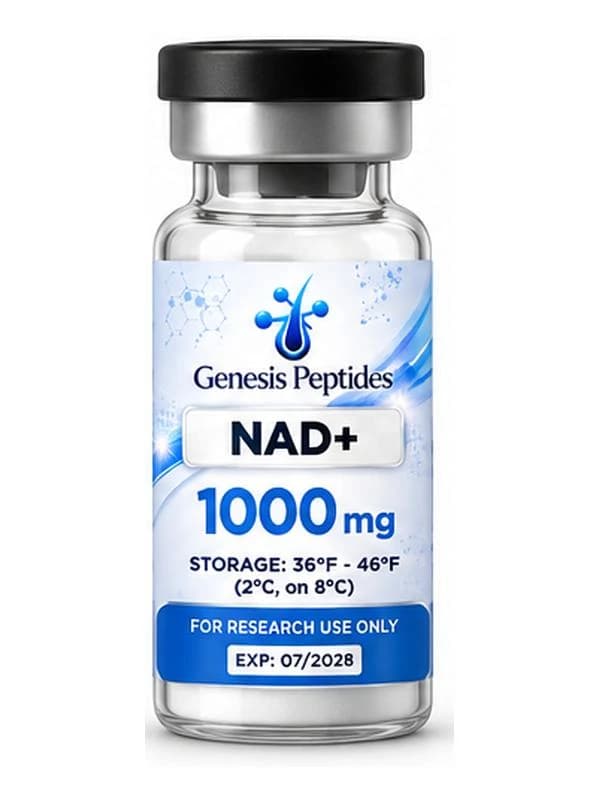
NAD+ UK 1000mg Research Compound for Laboratory Use
For laboratory research use only. Not for human or veterinary use. This product is not a medicine and not a food supplement. If you were searching for a NAD supplement UK shops sell to take by mouth, this is not that product, and questions about supplements are best taken to your GP or pharmacist.
- Batch-tested Certificate of analysis for every lot
- Research use only For laboratory research
- UK stock Dispatched from the UK
- Delivery from £6.05 Free over £100.00. Delivery policy
Research PeptidesResearch compound
Genesis Peptide NAD+ 1000mg Research Vial
Genesis Peptides supplies NAD+ (nicotinamide adenine dinucleotide, oxidised form) as a lyophilised research vial, dispatched from the UK.
- HPLC and mass spectrometry
- Research use only
£109.99no VAT charged
In stockUK stock, dispatched from the UK
- Strength
- 1000mg
- Product
- β-Nicotinamide adenine dinucleotide, oxidised form (NAD+), lyophilised powder
- Amount per vial
- 1000mg
- Appearance
- White to off-white powder
[INSERT MY APPROVED RESEARCH-USE WORDING]
Product Details and Specifications for This Research Compound
| Product | β-Nicotinamide adenine dinucleotide, oxidised form (NAD+), lyophilised powder |
|---|---|
| Amount per vial | 1000mg |
| Compound class | Dinucleotide coenzyme. Not a peptide |
| Molecular formula | C21H27N7O14P2 (free acid) |
| Molecular weight | about 663.4 g/mol (free acid) |
| CAS number | 53-84-9 (free acid) |
| Salt form | [free acid or sodium salt: CONFIRM from COA] |
| Purity (HPLC) | [≥ __% : CONFIRM batch figure] |
| Identity | [Mass spectrometry, batch-specific: CONFIRM it is on the COA] |
| Appearance | White to off-white powder |
| Vial | [__ml glass vial, rubber stopper, aluminium crimp cap: CONFIRM] |
| Testing lab | [Lab name, independent or in-house: CONFIRM] |
| Storage | −20 °C, sealed, dry and protected from light [CONFIRM against label] |
Each vial contains only NAD+ as a dry powder, with no filler, flavouring or other active ingredient. Our NAD+ UK range also includes a pre-mixed 1000mg research pen [LINK: NAD+ pen]. The vial suits work where you choose your own concentration and buffer, or need to store the compound for longer before use, because dry NAD+ keeps far better than NAD+ in solution.
What Is NAD+ and What Does It Do Inside Cells?
What’s NAD+, and what is n a d plus exactly? NAD+ is short for nicotinamide adenine dinucleotide, and the “+” shows it is the oxidised form, the one ready to accept electrons. If you have wondered what is nicotinamide adenine dinucleotide in plain terms, it is a small helper molecule that hundreds of enzymes need in order to work. That makes it a NAD coenzyme, and the answer to “is NAD a coenzyme?” is yes. Biochemists also call it a cofactor. So what is n.a.d in one line? A coenzyme that every living cell needs to turn food into usable energy.
Inside cells, NAD+ has two jobs:
- Electron carrier. In glycolysis and the citric acid (Krebs) cycle, NAD+ picks up electrons from food molecules and becomes NADH. NADH then hands those electrons to the mitochondria, where they are used to make ATP, and NAD+ is formed again. This cycle runs constantly in every cell.
- Fuel for signalling enzymes. Sirtuins, PARPs and the enzyme CD38 do not just borrow NAD+, they split it and release nicotinamide. This uses up cellular NAD, so cells keep remaking it, mostly by recycling nicotinamide through the salvage pathway.
So NAD+ what is it not? It is not a peptide. Search for “what is NAD peptide” and you will find it described that way on many sites, but NAD+ contains no amino acids. We list it alongside peptides only because the same laboratories use it. It is also not a supplement in this form: “what is n.a.d supplement” refers to capsule products sold as food, which are a separate category from this research compound. NAD+ was first identified in 1906 by Arthur Harden and William John Young as a heat-stable factor needed for yeast fermentation [VERIFY].
Chemical Structure, Formula and Molecular Weight
The structure of NAD, the coenzyme nicotinamide adenine dinucleotide, is two nucleotides joined through their phosphate groups. One nucleotide carries adenine (the same base found in ATP and DNA). The other carries a nicotinamide ring, which is a form of vitamin B3. The nicotinamide ring is the working part: it is where electrons are added and removed. That link between nicotinamide and NAD is also why nicotinamide is the main recycling route back to NAD+.
- Formula: C21H27N7O14P2 (free acid)
- Molecular weight: about 663.4 g/mol (monoisotopic about 663.11)
- CAS number: 53-84-9
- Solubility: freely soluble in water
A closely related molecule is NADP+, or nicotinamide adenine dinucleotide phosphate. It is NAD+ with one extra phosphate on the adenosine sugar, added by the enzyme NAD kinase (NADK). Cells use NADP+ and its reduced form NADPH mostly for building molecules and for antioxidant defence, while NAD+ and NADH are used mostly for breaking molecules down for energy. They are not interchangeable in enzyme work, so check which one your assay needs. This vial contains NAD+ only.
What Is the Difference Between NAD+ and NADH?
NAD+ and NADH are two states of the same molecule. So is NADH the same as NAD? Chemically it is the same compound carrying two extra electrons and one proton (together called a hydride). What is n a d h? It is the reduced form, written n a d h or NADH, that has picked up those electrons and carries them to the next reaction. Like NAD+, NADH is a coenzyme, so the answer to “is NADH a coenzyme?” is also yes.
| NAD+ | NADH | |
|---|---|---|
| Form | Oxidised (electron acceptor) | Reduced (electron donor) |
| Formula | C21H27N7O14P2 | C21H29N7O14P2 |
| Molecular weight | about 663.4 g/mol | about 665.4 g/mol |
| Absorbs at 340 nm | No | Yes, and fluoresces |
| Most stable in | Neutral to mildly acidic solution | Mildly alkaline solution |
The 340 nm difference is what most lab methods rely on: when an enzyme turns NAD+ into NADH, the solution starts absorbing UV light at 340 nm, so the reaction can be followed on a spectrophotometer. When people search for nicotinamide adenine dinucleotide NADH or nicotinamide NADH, this is the reduced NADH coenzyme they mean. This product is NAD+, the oxidised form.
How Is NAD+ Studied in Laboratory Research?
NAD+ is one of the most studied molecules in NAD biology and biochemistry generally. Laboratory work falls into three broad areas: its role as an electron carrier, its use by NAD+-consuming enzymes, and how cells make, move and break it down. It is used as a reagent in enzyme assays, and as the subject of study in cell and animal models. Nothing on this page describes an effect in people.
Cell Energy and Redox Chemistry Research
Many enzymes, called dehydrogenases, use NAD cofactor chemistry: they move a hydride from a substrate onto NAD+. Lactate dehydrogenase, malate dehydrogenase and GAPDH in glycolysis are common examples, and NAD+ is a standard reagent for measuring their activity. Each reaction turns NAD to NADH, and Complex I in the mitochondria turns it back.
- The NAD/NADH ratio. The balance between the two forms reflects a cell’s metabolic state, and it differs between the cytoplasm and the mitochondria. Measuring it is a common research readout.
- Other electron carriers. NAD+ works alongside FAD, a second coenzyme that carries electrons in the citric acid cycle. Research on FAD NADH handling in the mitochondria looks at how both feed the electron transport chain.
- Measuring NAD+. A NAD assay is usually an enzymatic cycling method, a colourimetric or fluorescent NAD/NADH assay kit, or LC-MS for the wider set of NAD-related molecules. A NAD NADH assay often measures the two forms separately by destroying one with acid or alkali first, which works because NAD+ survives acid and NADH survives alkali.
Sirtuin and PARP Enzyme Research
Two families of enzymes use NAD+ as a cofactor NAD they consume rather than recycle:
- Sirtuins (SIRT1 to SIRT7) remove acetyl and other groups from proteins, and can only do so using NAD+. A 2000 study in yeast showed the sirtuin Sir2 is an NAD-dependent deacetylase [VERIFY]. Because their activity depends on NAD+ supply, sirtuins are studied as a link between cell metabolism and gene regulation.
- PARPs (poly(ADP-ribose) polymerases), especially PARP1, use NAD+ to build chains of ADP-ribose at sites of DNA damage, which recruit repair proteins. Heavy DNA damage can drain NAD+, so DNA repair studies often measure NAD+ alongside PARP activity.
Both reactions split NAD+ and release nicotinamide, which cells then recycle back into NAD+ through the enzyme NAMPT. This nicotinamide NAD loop matters in experiments because nicotinamide itself slows sirtuins down. That is why studies of NAD+, NADH and nicotinamide levels (searched as NADH nicotinamide) usually measure all three.
Can Cells Take Up NAD+ Directly in Research Models?
Mostly not as intact NAD+, as far as current evidence shows, though this is still debated. NAD+ is a large, charged molecule that does not pass easily through cell membranes. In a 2020 study, NAD+ added to cell culture medium containing serum was broken down outside the cells into NMN, NR and nicotinamide, and no intact NAD+ was found in the medium after exposure to cells. In serum-free medium it stayed intact (Wilk et al., 2020). Enzymes on the cell surface, such as CD38 and CD73, are involved in breaking down NAD+ and its products outside the cell.
Some studies propose routes for intact NAD+, such as connexin 43 channels in certain cell types [VERIFY]. Inside the cell, NAD+ is moved into mitochondria by a dedicated transporter, SLC25A51, identified in 2020 [VERIFY]. For experiment design, this means NAD+ added to culture medium may act through its breakdown products. Researchers often run NMN, NR or nicotinamide controls and check whether their medium contains serum.
What Does Current Evidence Say About Human Studies?
Very few published human studies have used NAD+ itself. One small pilot study gave a six-hour intravenous infusion of NAD+ to 8 healthy men, with 3 men given saline, and measured NAD+ and related molecules in blood and urine. Blood NAD+ did not rise until after 2 hours (Grant et al., 2019). It measured levels, not health outcomes, and was too small to draw conclusions about safety.
Most human research uses the precursors NR and NMN instead, in trials that measure blood NAD+ levels and a range of other markers, with mixed results. NAD+ is not a licensed medicine in the UK, and none of this research supports using this product in people. This vial is supplied for laboratory research only.
NAD+ vs NMN vs NR: What Is the Difference in Research?
NMN (nicotinamide mononucleotide) and NR (nicotinamide riboside) are precursors: smaller molecules that cells turn into NAD+. They are often called a NAD booster for that reason. Many products sold as a NAD+ supplement, NAD plus supplement or NAD + supplement actually contain one of these precursors rather than NAD+ itself. That is consumer food-supplement territory, regulated separately and not what this vial is.
| NAD+ | NMN | NR | |
|---|---|---|---|
| What it is | The coenzyme itself | Precursor, one step from NAD+ | Precursor, two steps from NAD+ |
| Approx. molecular weight | 663 g/mol | 334 g/mol | 255 g/mol (about 291 as the chloride salt) |
| How cells make NAD+ from it | Already NAD+ | NMNAT enzymes add AMP | NRK1/NRK2 turn it into NMN first |
| Gets into cells intact? | Poorly; often broken down outside first | Debated; often converted to NR outside | Yes, through nucleoside transporters |
| Typical lab use | Enzyme assays, cell-free systems, extracellular NAD+ and CD38 studies | Raising NAD+ inside cells in models | Raising NAD+ inside cells in models |
In short, NAD+ is the right choice when your experiment needs the coenzyme directly, such as an enzyme reaction in a tube. Precursors are used when the aim is to change NAD+ levels inside cells or animals. Unlike most NAD supplements, which are sold in capsules for people, this vial is supplied as a characterised research chemical with a batch COA.
Certificate of Analysis and Purity Testing for Each Batch
Every batch of our NAD+ comes with a certificate of analysis (COA) from [CONFIRM: lab name] [independent third-party lab: CONFIRM]. The COA shows HPLC purity and [mass spectrometry identity: CONFIRM], matched to the batch number on your vial. Purity matters more for NAD+ than people expect, because its breakdown products (nicotinamide and ADP-ribose) and NADH are all colourless, so a vial can look normal and still be degraded.
How to Find and Download the Certificate for Your Batch
- Find the batch number on your vial label [and on the packing slip: CONFIRM].
- Go to [LINK: COA library page], or use the COA link in the product images on this page.
- Choose the certificate whose batch number matches your vial and download the PDF.
- If you cannot find your batch, contact us at [CONFIRM: email] and we will send it.
How to Read HPLC Purity Results
- The main peak is NAD+, usually detected by UV at 260 nm, where the adenine part absorbs. Purity is that peak’s area as a percentage of all peaks. This batch: [CONFIRM: __%].
- Smaller peaks are likely to be related molecules: nicotinamide, ADP-ribose, AMP, NADH or NADP+. A rising nicotinamide or ADP-ribose peak in an older batch is a sign of breakdown.
- Mass spectrometry (if shown) confirms identity. For NAD+ the protonated ion [M+H]+ appears at about m/z 664.1, or [M−H]− at about 662.1 in negative mode [VERIFY against COA].
- What HPLC does not show: the exact amount in the vial (unless an assay against a reference standard was run), water content, or sterility. A purity of exactly 100% is a warning sign, because real results almost never show it.
- Check the details: product name, salt form, batch number, test date and lab name should all be on the certificate.
How to Store and Handle a Lyophilised Research Vial
Dry NAD+ is far more stable than NAD+ in solution. It also absorbs water from the air readily, and moisture speeds up breakdown, so keep the vial sealed, dry and cold. Before opening a cold vial, let it reach room temperature so moisture does not condense on the powder. Handle with gloves, using sterile technique, in a lab setting.
Storage Before and After Reconstitution
- Before reconstitution: sealed vial at −20 °C for long-term storage, protected from light. Short periods at 2–8 °C are generally fine for the dry powder [CONFIRM in-house guidance]. Unopened shelf life: [__ months: CONFIRM].
- Reconstitution: NAD+ dissolves readily in water. Laboratories typically use sterile water, bacteriostatic water [LINK: bac water] or a buffer chosen for the assay. Avoid alkaline buffers, because NAD+ breaks down quickly above about pH 8; a neutral or mildly acidic solution is more stable [VERIFY].
- After reconstitution: store at 2–8 °C, protected from light, and use within [__ days: CONFIRM from your stability data]. For longer storage, split the solution into single-use aliquots and freeze them at −20 °C or below, and avoid repeated freezing and thawing.
- Discard any solution that turns cloudy, yellow or brown, or contains particles.
Is Research Use of This Compound Legal in the UK, and Is It Banned in Sport?
[LEGAL REVIEW: this section]
- Not a controlled drug. NAD+ is not listed under the Misuse of Drugs Act 1971 or the Psychoactive Substances Act 2016 [VERIFY].
- Not a licensed medicine. NAD+ has no UK marketing authorisation from the MHRA. Under the Human Medicines Regulations 2012, a product presented for treating people, or for changing how the body works, counts as a medicine whatever it contains. That is why this product is sold for research only, with no health claims.
- Not a food supplement. A NAD+ supplement UK shops sell is a food product, regulated under food law, made for eating and limited to permitted claims. NAD supplements UK retailers sell are therefore a different category from this vial, which is a research chemical and is not sold for human consumption.
- Research supply. Buying NAD+ UK stock as a research chemical, labelled and sold for laboratory use, is the basis on which we supply it [LEGAL REVIEW]. We will not sell to anyone who says they intend to use it on a person or an animal.
Is it banned in sport? NAD+ is not named on the World Anti-Doping Agency (WADA) Prohibited List. However, intravenous infusions or injections of more than 100 mL in any 12-hour period are a prohibited method in and out of competition, whatever they contain, unless received during hospital treatment or with an exemption [VERIFY against the 2026 list, section M2.2]. Athletes covered by UK Anti-Doping (UKAD) rules should check with UKAD before any contact with an unlicensed compound.
What to Check Before Buying Research Compounds in the UK
Lists of the best NAD+ supplement UK or best NAD supplement UK products compare capsules for people, on price per dose and ingredients. Research compounds need different checks:
- A batch-matched COA with HPLC purity, ideally with mass spectrometry identity, from a named lab.
- The exact compound and form. The listing should say NAD+ (not NADH, NMN or NR), the amount per vial, and whether it is the free acid or a salt.
- An accurate description. A seller that calls NAD+ a peptide, or calls a research chemical the best NAD supplement, may not understand what they sell or the rules that apply to it.
- Clear research-use labelling and no dosing, health or anti-ageing claims.
- A UK address and contact details, and dispatch from the UK.
- Sensible storage advice: NAD+ should be shipped and stored dry and sealed, and the seller should tell you how to keep it cold once it arrives.
To order from Genesis, add the 1000mg vial to your basket at the top of this page.
UK Delivery, Dispatch and Packaging
- Dispatch: orders placed before [CONFIRM: time] on a working day are dispatched the same day from [CONFIRM: town/county].
- Delivery: [CONFIRM: carrier and service, e.g. Royal Mail Tracked 24], [CONFIRM: price / free over £__].
- Packaging: vials are sealed and packed in [CONFIRM: protective packaging details], in plain outer packaging. Dry NAD+ is stable at room temperature for the length of normal UK transit; put it in the freezer on arrival [CONFIRM].
- Payment: [CONFIRM: payment methods].
Our NAD UK stock is held and shipped within the UK, so there are no customs delays, and every NAD+ UK order includes the batch number on the packing slip for COA lookup. For larger lab orders, contact [CONFIRM: email].
Scientific References and Published Studies
Key published studies on NAD+ cited on this page:
- Harden A, Young WJ. The alcoholic ferment of yeast-juice. Proc R Soc Lond B. 1906;77:405–420. [VERIFY]
- Imai S, Armstrong CM, Kaeberlein M, Guarente L. Transcriptional silencing and longevity protein Sir2 is an NAD-dependent histone deacetylase. Nature. 2000;403:795–800. [VERIFY]
- Trammell SAJ, Schmidt MS, Weidemann BJ, et al. Nicotinamide riboside is uniquely and orally bioavailable in mice and humans. Nat Commun. 2016;7:12948. [VERIFY]
- Grant R, Berg J, Mestayer R, et al. A pilot study investigating changes in the human plasma and urine NAD+ metabolome during a 6 hour intravenous infusion of NAD+. Front Aging Neurosci. 2019;11:257. doi:10.3389/fnagi.2019.00257
- Wilk A, Hayat F, Cunningham R, et al. Extracellular NAD+ enhances PARP-dependent DNA repair capacity independently of CD73 activity. Sci Rep. 2020;10:651.
- Luongo TS, Eller JM, Lu MJ, et al. SLC25A51 is a mammalian mitochondrial NAD+ transporter. Nature. 2020;588:174–179. [VERIFY]
- Covarrubias AJ, Perrone R, Grozio A, Verdin E. NAD+ metabolism and its roles in cellular processes during ageing. Nat Rev Mol Cell Biol. 2021;22:119–141. [VERIFY]
- Yoshino M, Yoshino J, Kayser BD, et al. Nicotinamide mononucleotide increases muscle insulin sensitivity in prediabetic women. Science. 2021;372:1224–1229. [VERIFY]
- World Anti-Doping Agency. Prohibited List 2026, M2 Chemical and Physical Manipulation.
[CHECK: add DOI or PubMed links before publishing]
Related Research Compounds and Buying Guides
- NAD+ 1000mg research pen [LINK: NAD+ pen]: the same compound, supplied pre-mixed in a cartridge, if you would rather not reconstitute.
- Bacteriostatic water [LINK: bac water]: for reconstituting lyophilised vials.
- Epitalon [LINK: epitalon vial] and GHK-Cu [LINK: GHK-Cu vial]: other compounds often studied in ageing-biology labs.
- Guides: [LINK: how to read a COA], [LINK: storing research compounds] and the [LINK: Reconstitution Calculator], which works for NAD+ as well as peptides.
All NAD+ UK products and related compounds are for laboratory research use only. Not for human or veterinary use.
FAQ
Frequently Asked Questions
Quick answers on batch testing, delivery and ordering. Can’t find what you need? Our team is happy to help.
Contact UsWhat is inside a NAD+ vial?
Only NAD+ (β-nicotinamide adenine dinucleotide, oxidised form) as a dry, white to off-white powder, 1000mg per vial, as the [free acid or sodium salt: CONFIRM]. There is no water, filler or other active ingredient, and no peptide.
Is NAD+ the same as NAD plus?
Yes. “NAD plus” is just how NAD+ is said out loud, and NAD is often written without the plus sign. All three usually mean the oxidised form of nicotinamide adenine dinucleotide. A product sold as a NAD plus supplement may contain NAD+ or a precursor such as NR or NMN, so check the label; this vial contains NAD+ and is for research only.
Are there any human studies on NAD+?
A few, and they are small. The best-known study of NAD+ itself gave an intravenous infusion to 8 healthy men and measured blood and urine levels (Grant et al., 2019). Most human research uses the precursors NR and NMN instead. None of it makes NAD+ a licensed medicine, and this product is not for human use.
Is NAD+ legal to buy in the UK?
Yes, for research. NAD+ is not a controlled drug, and buying NAD+ UK research stock for laboratory use is legal [LEGAL REVIEW]. It is not a licensed medicine, so it cannot be sold for treating people, and this product is not sold as a NAD supplement UK food product either.
Is this product third party tested?
[CONFIRM: Yes, every batch is tested by (lab name), an independent laboratory]. The certificate for each batch shows HPLC purity [CONFIRM: and mass spectrometry identity], and you can download it using the batch number on your vial.
How long can it be stored once reconstituted?
Kept at 2–8 °C and protected from light, use the solution within [__ days: CONFIRM from your stability data]. For longer storage, freeze it in single-use aliquots at −20 °C or below. Keep the solution neutral or mildly acidic, as NAD+ breaks down quickly in alkaline conditions.
Calculator
Peptide Reconstitution Calculator
Enter the amount in the vial, the volume of diluent added and the amount you need. The calculator works out the concentration and the volume to measure.
- Volume to measure
- 0.001 ml
- 0.5 µl
- Concentration
- 500,000 mcg/ml
- 500 mg/ml
- Portions per vial
- 4000
- at 250 mcg each