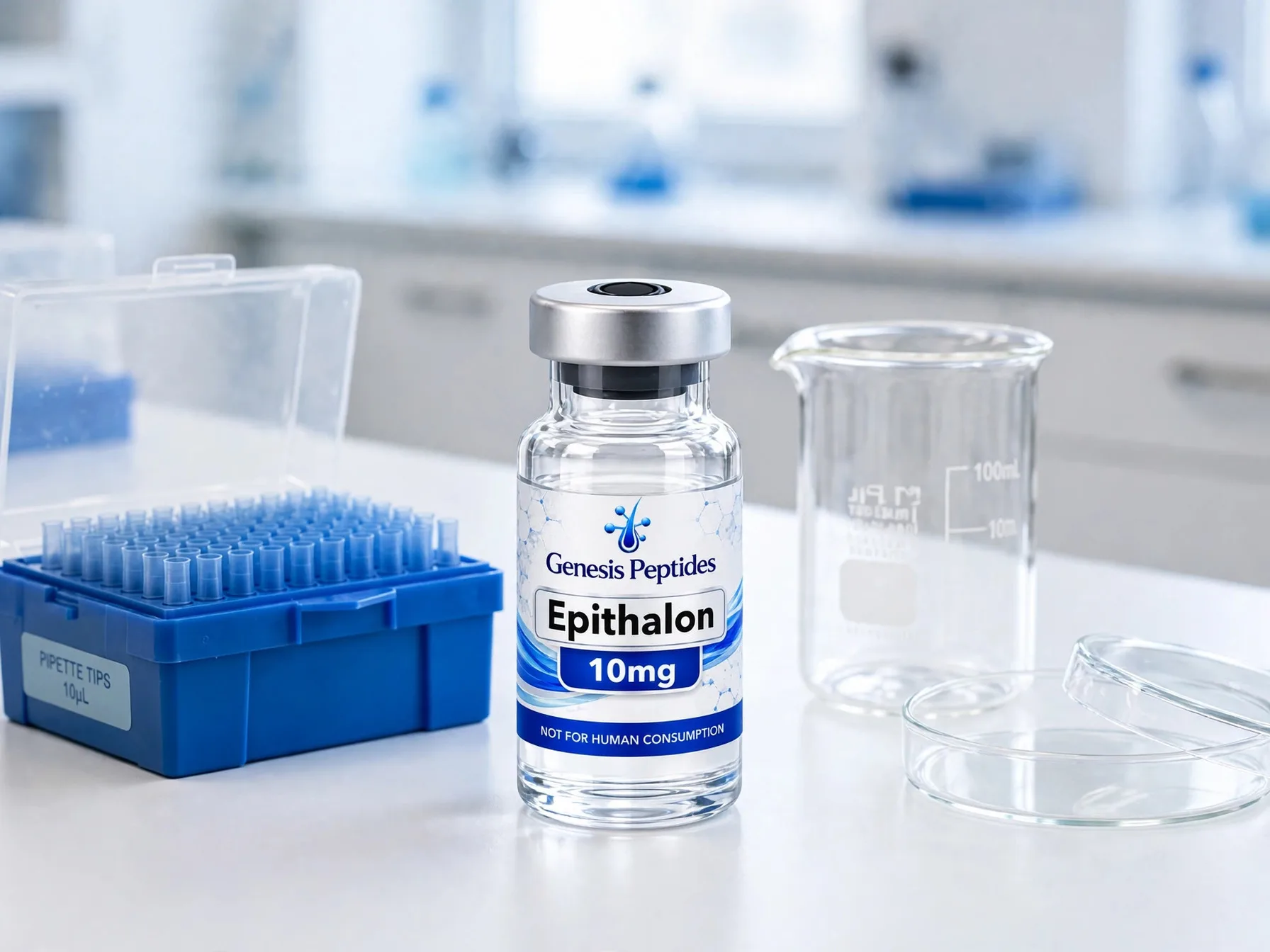
So what does epitalon peptide do? Epitalon sounds like the name of an ancient Greek hero but it is really just four tiny amino acids. People also spell it epithalon. It is a short peptide that was designed from a natural pineal gland extract and it is studied mostly for sleep and ageing. The science behind it is interesting but it is also early. This guide explains what epitalon is and what it is used for in research and what is still unproven.
Epitalon is sold today as a research peptide. It is not approved by the FDA for any use. We will keep every claim in this guide tied to what research actually shows.
What Is Epitalon?
Epitalon is a synthetic tetrapeptide. That means it is built from just four amino acids. They are listed here in order.
- Alanine
- Glutamic acid
- Aspartic acid
- Glycine
Scientists often shorten this to AEDG after the first letter of each amino acid.
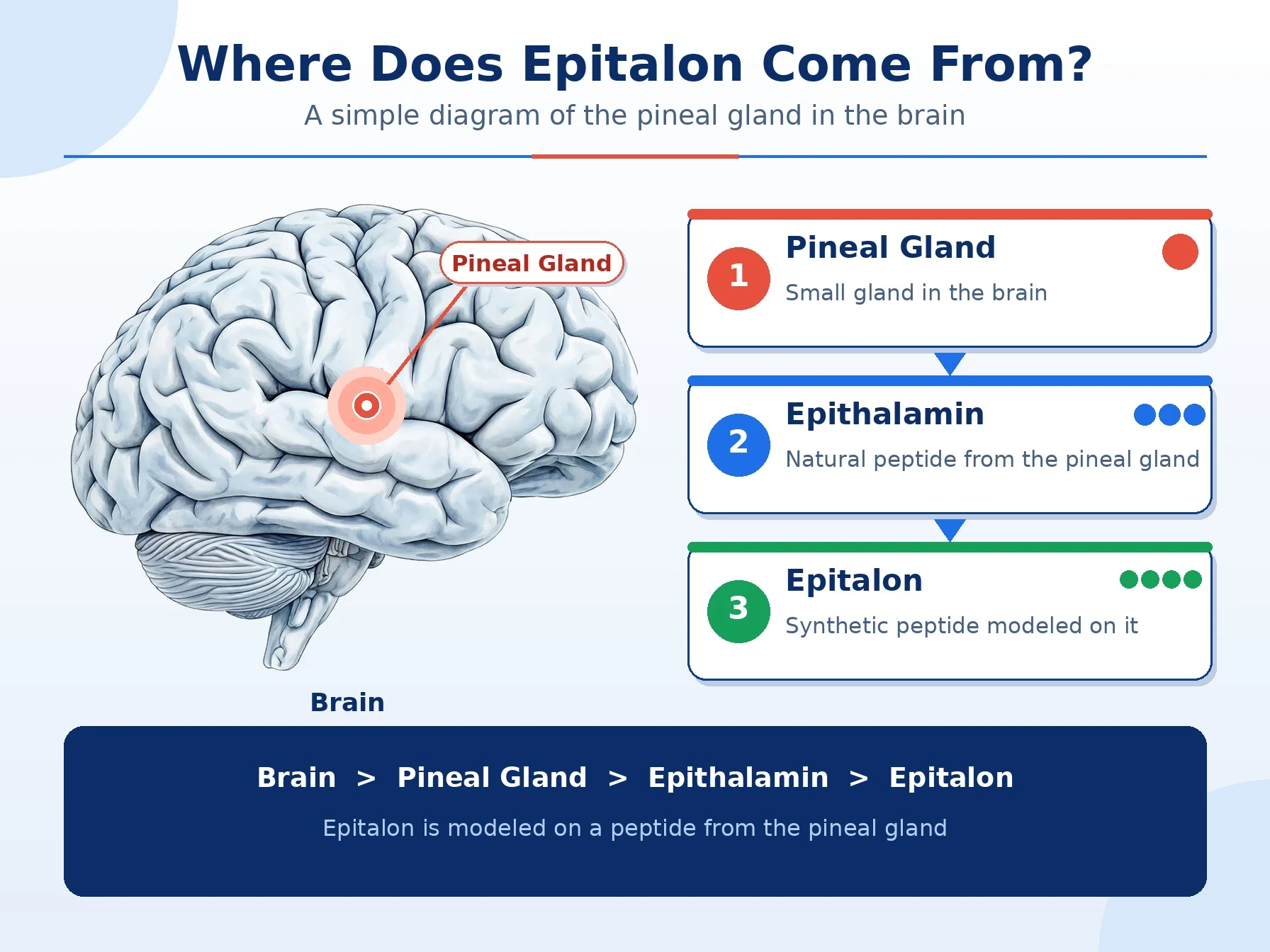
Epitalon was designed from a natural product called Epithalamin. Epithalamin is an extract from the pineal gland of cattle. The pineal gland is a tiny gland in the brain that helps control your sleep and wake cycle through the hormone melatonin. Researchers believed that AEDG was the active piece inside the extract so they made it in the lab.
Who Discovered Epitalon?
Epitalon came from the laboratory of Vladimir Khavinson at the St Petersburg Institute of Bioregulation and Gerontology in Russia. Khavinson studied short peptides for many years and wanted to learn whether they could help the body regulate itself as it ages. His work also covered peptides linked to other organs such as the thymus.
Much of the published research on epitalon comes from this same research group. This matters because independent teams have repeated only part of the work. We will return to this point in the science section.
What Are Bioregulators?
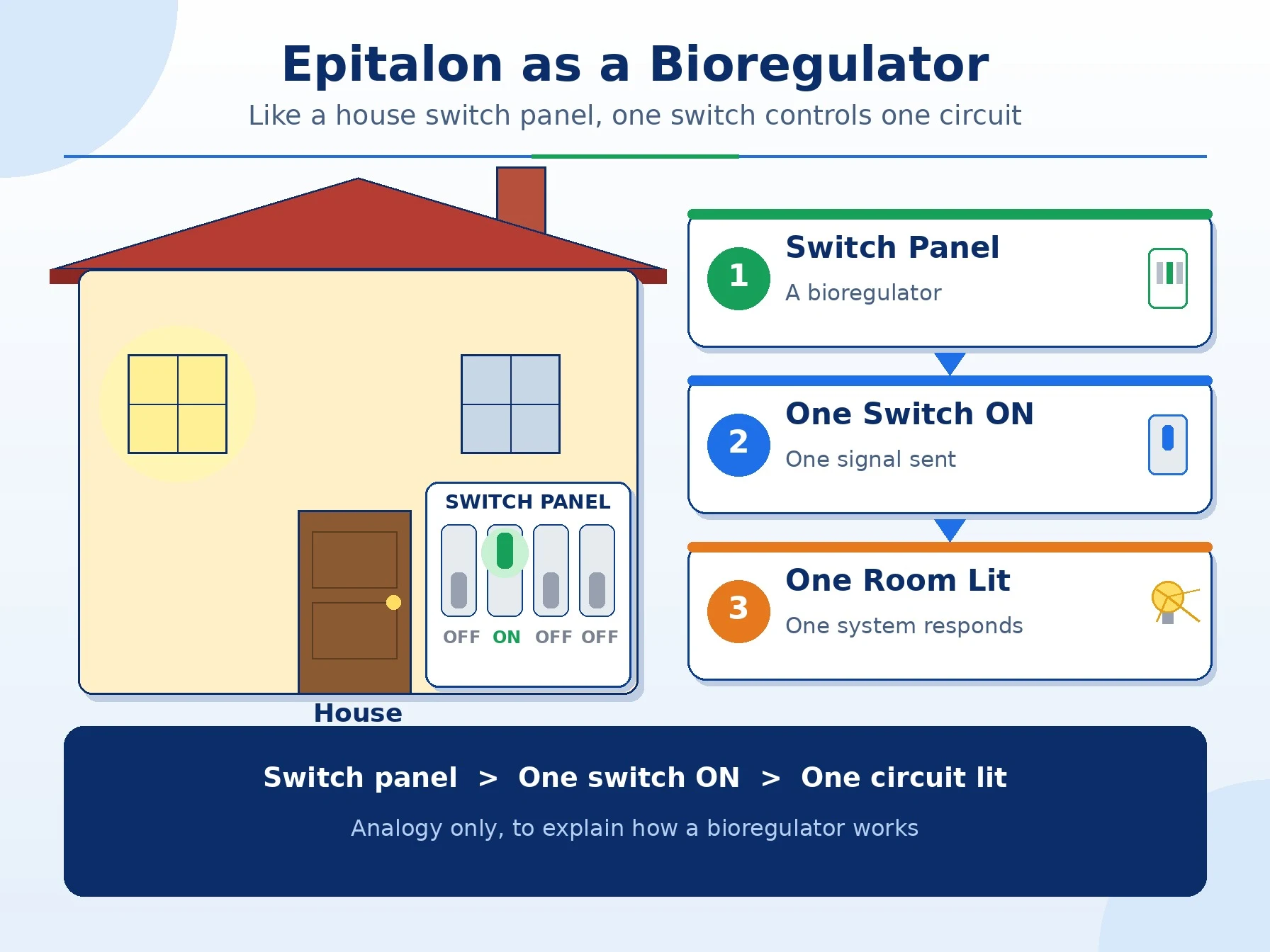
Epitalon is often called a peptide bioregulator. Here is a simple way to picture the idea. In a house every room has its own switch. Somewhere outside there is also a main panel that controls the whole supply.
Most research peptides work like room switches. They are studied for one job such as growth hormone release or tissue repair. Bioregulators are described as closer to the main panel. The idea is that they send a broad signal that helps a whole organ or system run in a balanced way.
This idea comes from the researchers who developed these peptides and it is still being tested. It is a helpful picture but it is not settled science.
What Does Epitalon Peptide Do?
Researchers have studied epitalon in three main areas. Each area has a different level of evidence.
In short epitalon is studied for its possible effects on the pineal gland and on how cells age. Researchers do not use it as a proven treatment. The uses below are research uses and each one has a different level of evidence.
Epitalon and Sleep
The pineal gland makes melatonin. Because epitalon came from a pineal extract researchers looked at melatonin first. In a randomized study of 75 women those who received epitalon showed higher levels of a melatonin breakdown product in urine compared with placebo. Animal and cell studies point in the same direction.
This is encouraging but it is a small study. It measured melatonin related markers and it did not prove better sleep in everyday life.
Epitalon and Telomeres
Telomeres are protective caps on the ends of chromosomes. They get shorter as cells divide. An enzyme called telomerase can rebuild them. In cell culture studies epitalon increased telomerase activity in human cells and helped some cells keep dividing for longer. A 2025 laboratory study was also reported to repeat this effect.
This is the main reason epitalon is linked with anti ageing. It is important to be honest here. These results come from cells in a dish. No controlled human trial has shown that epitalon lengthens telomeres in the human body.
Epitalon and Lifespan in Animals
Studies in fruit flies and mice have reported lower markers of oxidative damage and signs of better cell health. Some of the animal work also looked at tumour rates. These studies are useful for finding ideas to test. They cannot tell us what would happen in people.
What Is Epitalon Peptide Used For?
When people ask about the uses of epitalon they usually mean the areas where it is studied. Here are the main ones.
- Sleep and circadian rhythm research. Scientists look at how epitalon affects melatonin signals from the pineal gland.
- Cellular ageing research. Epitalon is used in cell studies to explore telomerase activity and how long cells keep dividing.
- Pineal gland research. Because it came from a pineal extract it is used to study how this small gland changes with age.
- Oxidative stress research. Animal studies have looked at markers of cell damage and cell health.
- Cancer related animal research. Some studies in mice and rats looked at tumour rates. These are animal models only and they do not show an effect in people.
Wellness websites often list many more uses such as better skin or more energy or a longer life. Those claims go beyond the current evidence. There are no large human trials that prove epitalon works for any of them.
What Epitalon Is Not
Epitalon is not an approved medicine. It is not a proven anti ageing treatment. It is not a replacement for medical care or for the basics of sleep and food and movement.
Epitalon Evidence at a Glance
| Area | What research found | Strength of evidence |
|---|---|---|
| Melatonin and sleep markers | Higher melatonin breakdown product in one small randomized study | Low to moderate and small |
| Telomerase in cells | Higher telomerase activity in human cell cultures | Lab only and not shown in people |
| Animal lifespan and health | Better health markers in flies and mice | Animal only |
| Human lifespan or anti ageing | No controlled human trial shows a benefit | Not established |
| Long term human safety | No large human safety studies published | Unknown |
What Are the Limits of the Evidence?
Here is the honest picture. The most famous human longevity study looked at 266 older adults in 2003. It tested Epithalamin and related extracts and not the synthetic epitalon peptide. It also had no placebo group.
- Most human data are small and old
- Many studies come from one research group in Russia
- There are no large randomized trials on ageing or lifespan
- Several supporting papers are early preprints that are not yet peer reviewed
- Only one form of the peptide has been studied closely
You may see websites claim that epitalon has no side effects. That claim goes further than the data. A lack of reported problems is not the same as proof of safety. No large human safety studies exist.
Is Epitalon Safe?
Nobody can give a final answer yet. Studies have not reported major problems but they are few and small. Researchers also point out one theoretical concern. Telomerase helps cells keep dividing so scientists want to know if boosting it could ever help harmful cells grow. This has not been studied properly in humans.
Reactions to any injected peptide are possible. These can include redness or itching where it is given and in rare cases a wider allergic reaction. Low quality products can also cause problems because of contamination.
This blog is for education only and is not medical advice. Always speak with a qualified doctor about your own health.
Why Lifestyle Still Matters
Research peptides get a lot of attention but they sit on top of the basics. Sleep and food and movement send strong signals to the body every day. A peptide is not a magic wand and it is certainly not a replacement for a good night of sleep.
Experts who work with peptides often say the same thing. A peptide cannot cancel out poor habits. This is a sensible point when you read about any anti ageing claim.
Why Quality and Sourcing Matter
Because the evidence is still growing the quality of the material matters even more. Peptides from unclear sources can be mislabelled or contaminated. When a vial is not what the label says every result becomes hard to trust.
At Genesis Peptides we supply research peptides in the UK. Our products are for laboratory research use only and not for human consumption. We believe every researcher deserves clear information and honest labelling.
Looking for Research Peptides in the UK?
Genesis Peptides is here to help UK researchers find the right peptides with clear and honest information. Our products are for research use only. Have a question about research peptides? Call us or message us on WhatsApp at +44 7343 047659 and our team will be happy to help.
Conclusion
So what is epitalon and what does epitalon peptide do? It is a four amino acid peptide designed from a pineal gland extract and studied for sleep and ageing. Cell and animal studies show some interesting effects on melatonin and telomerase. Human evidence is still small and mostly from one research group.
The honest summary is that epitalon is a promising research topic and not a proven anti ageing tool. Keep your expectations realistic and always choose a source you can trust. Genesis Peptides is here to support your research with clear information and honest labelling.
Frequently asked questions
Is epitalon the same as epithalon?
Yes. Epitalon and epithalon are two spellings of the same peptide. Both names refer to the four amino acid peptide known as AEDG. It was designed from Epithalamin which is a pineal gland extract. You will see both spellings in studies and on websites.
What does epitalon peptide do?
Research suggests epitalon may influence melatonin signals and telomerase activity. Most of this evidence comes from cell and animal studies. One small human study reported higher melatonin markers. No large human trial has shown a benefit for ageing or lifespan.
What is epitalon peptide used for?
Epitalon is used in research on sleep and melatonin and on cellular ageing and telomerase. It is also used to study the pineal gland. It is not an approved treatment for any condition. Claims about skin or energy or lifespan are not backed by large human trials.
Does epitalon lengthen telomeres?
In human cell cultures epitalon has raised telomerase activity and helped some cells divide for longer. This has not been shown in living people. No controlled human trial has measured telomere length before and after use. The result is promising but unproven.
Does epitalon help with sleep?
It may affect melatonin but better sleep is not proven. A randomized study in 75 women reported higher levels of a melatonin breakdown product compared with placebo. That measures a marker and not sleep quality. Larger studies are needed to answer this question.
Is epitalon approved by the FDA?
No. Epitalon is not approved by the FDA for any use and it is sold as a research peptide. Rules for peptides are changing in some countries so it is wise to check the latest guidance. Anyone with health questions should speak with a qualified doctor.
What are the side effects of epitalon?
Large human safety studies do not exist so the full picture is unknown. Reactions to any injected peptide can include redness or itching at the site and rare allergic reactions. Contaminated products add extra risk. Stop right away and speak with a doctor if a reaction appears.
Why is epitalon called a bioregulator?
Researchers use the word bioregulator for short peptides they believe help an organ or system keep its normal balance. Epitalon is linked with the pineal gland. This is the view of the research group that developed it and it is still being tested by others.