

MOTS-c has a name that looks like a typing mistake and a job that is anything but small. It is a tiny peptide made inside your mitochondria and it helps your cells decide how to use energy. If you have heard the hype and want the facts then this guide is for you.
Most of the exciting results come from mice and rats. MOTS-c is not an approved medicine and it is sold as a research peptide. We will go through what is known and what is still unknown so you can read the science with clear eyes.
What Is MOTS-c?
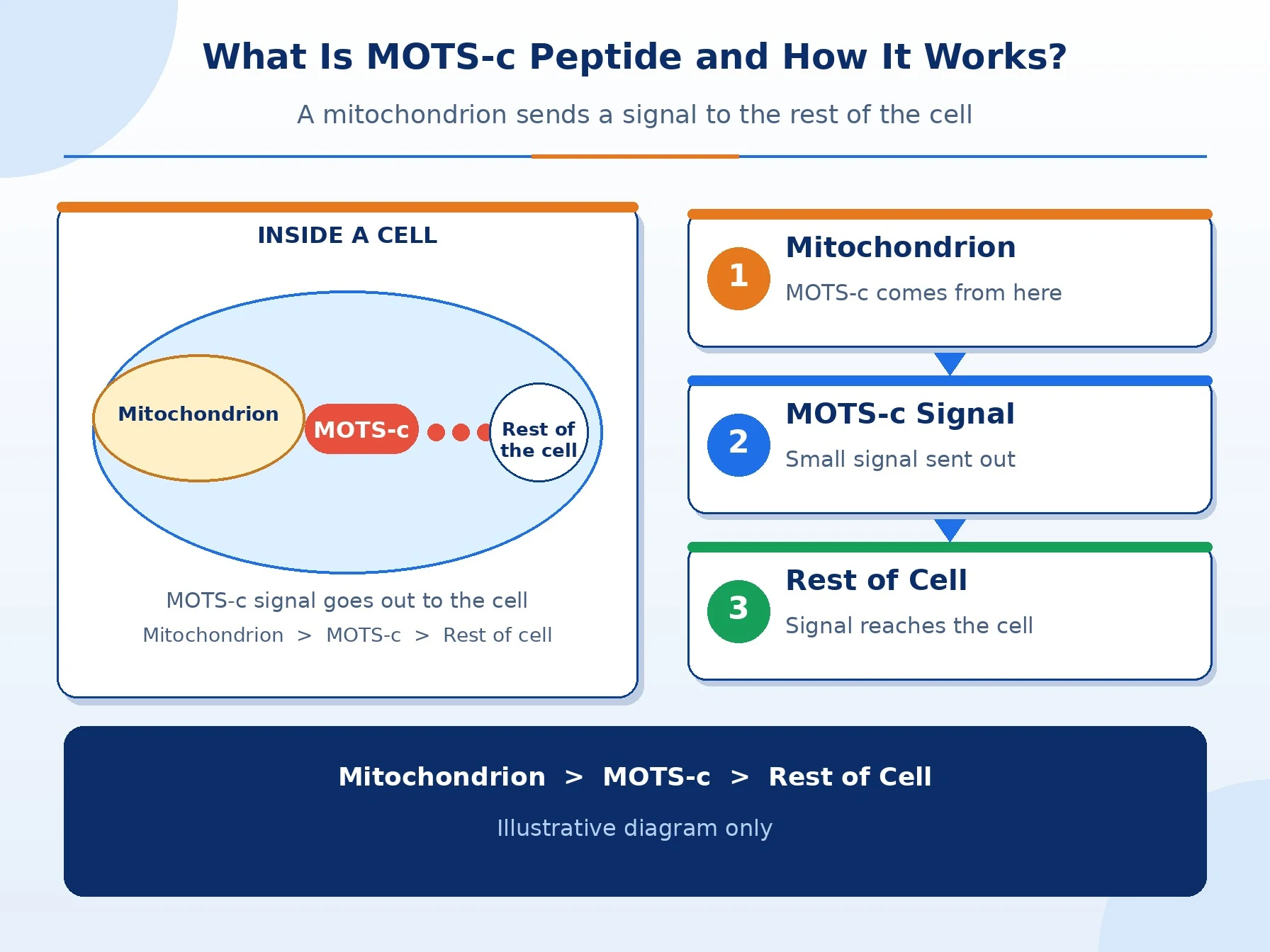
MOTS-c is a peptide made of 16 amino acids. Its full name is mitochondrial open reading frame of the 12S rRNA type c. You do not need to remember that. What matters is where it comes from.
Most proteins are built from instructions in the DNA in the nucleus of a cell. MOTS-c is different. It is built from instructions in the small amount of DNA that sits inside the mitochondria. Mitochondria are the tiny parts of a cell that turn food and oxygen into usable energy. Researchers at the University of Southern California reported MOTS-c in 2015.
Because it is a peptide it works as a signalling molecule. Think of it as a short message sent from the mitochondria to the rest of the cell. The message is about energy.
When Does Your Body Make MOTS-c?
Your body makes some MOTS-c all the time. Levels rise when the body faces metabolic stress. Exercise is the best studied trigger. In a human study from the USC team healthy young men cycled on a stationary bike. MOTS-c in their muscle rose nearly 12 times after exercise and blood levels rose by about half before returning to normal after rest.
Researchers also link MOTS-c to other stressors such as fasting and lower calorie intake and temperature extremes. Most of that evidence comes from lab work so it is best read as promising and not proven.
Levels are also thought to fall with age. That may be one reason cells become less flexible with energy as we get older. This idea is still being tested in people.
How Does MOTS-c Work?
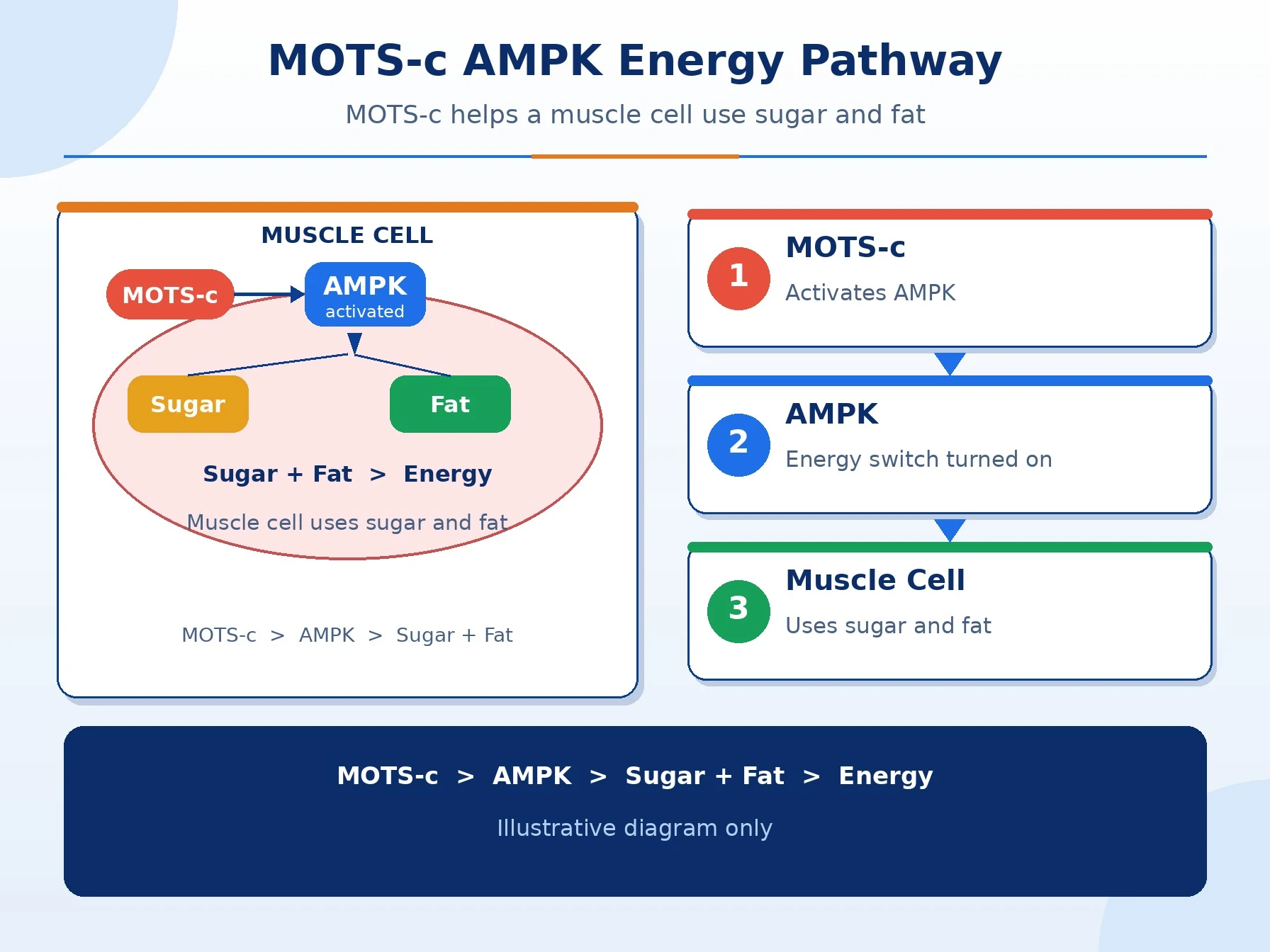
The main idea is simple. MOTS-c helps switch on an enzyme called AMPK. AMPK is often called the fuel gauge of the cell. When energy runs low AMPK tells the cell to use fuel more carefully.
- It helps muscle cells take up sugar from the blood. This is linked to better insulin sensitivity.
- It supports the burning of fatty acids for fuel.
- It is linked to the making of new mitochondria which gives cells more capacity to produce energy.
Some people call MOTS-c an exercise mimetic because these effects look a bit like the effects of training. That is a catchy phrase but it is only a comparison. Taking a peptide is not the same as exercising and no research has shown that it can replace training.
What Does the Research Show?
Metabolic health in mice
The first big paper in 2015 gave MOTS-c to mice. When mice ate a high fat diet and received MOTS-c they were protected from gaining excess weight and from developing insulin resistance. In mice that were already insulin resistant the treatment improved insulin sensitivity. These are results in mice and they do not tell us what would happen in people.
Physical performance and ageing in mice
A 2021 study tested mice at three ages. Treated mice did better on running and balance tests at every age. In the oldest mice MOTS-c given late in life roughly doubled treadmill running capacity and improved grip strength and walking. These mice were compared to humans of around 65 and older. Again this is animal work.
Other animal findings
Lab studies have looked at several other areas. In diabetic rats MOTS-c reduced the thickness of the heart wall back to normal levels. Studies in mice also suggest it may help protect bone after the loss of oestrogen. These areas are early and each one needs far more research.
What do human studies say?
Human data is small. Exercise raises MOTS-c in people and that is well supported. Some small observational studies link lower MOTS-c levels with obesity and insulin resistance. That tells us about association and it does not prove that adding MOTS-c would fix anything.
A related experimental peptide called CB4211 was built from MOTS-c and tested in an early human trial in adults with fatty liver and obesity. The drug was reported as generally well tolerated and the most common reactions were at the injection site. Liver fat fell in both the treated group and the placebo group so the result was not clear. CB4211 is not the same molecule as MOTS-c and it did not move on to a later stage.
MOTS-c and cancer
The cancer story goes in two directions. A 2024 study in the journal Advanced Science found that MOTS-c levels were lower in ovarian cancer patients and that MOTS-c slowed ovarian cancer cells in the lab and in mice. At the same time some experts raise a theoretical worry that boosting energy pathways could help certain cancer cells grow. Neither side is settled so this is an area to watch with care.
Evidence at a Glance
| Area | What research found | Strength of evidence |
|---|---|---|
| Exercise and MOTS-c levels | Levels rise in muscle and blood after exercise | Human data but small studies |
| Weight and insulin resistance | Protection from diet induced obesity in mice | Animal only |
| Ageing and physical capacity | Better running and strength in old mice | Animal only |
| Heart and bone | Improvements in diabetic rats and in mice after oestrogen loss | Early animal work |
| Cancer | Mixed lab findings with an unsettled theoretical concern | Unclear |
Possible Side Effects and Safety Points
There are no proper human safety studies of MOTS-c so the full risk picture is not known. People who buy peptides online have reported a few problems. Reports include the following.
- Large and lingering welts or irritation at the injection site
- A jittery or anxious feeling and a faster heart rate
- Trouble sleeping
- Possible drops in blood sugar because MOTS-c acts on pathways linked to glucose use
- Fever or other immune type reactions
Many of these come from personal reports and not from controlled trials so they should be read as warning signs and not as exact rates. People who take diabetes medicines or who have a history of cancer should speak with a qualified doctor before thinking about any experimental peptide.
MOTS-c is not approved by the FDA as a medicine. It is also on the WADA prohibited list at all times so competitive athletes must avoid it. This blog is for education only and is not medical advice.
Why Quality and Sourcing Matter
A peptide is only as good as the vial it comes in. Products from unclear sources can be weak or mislabelled or contaminated. A vial with no clear label is like a parcel with no address and nobody should have to guess where it came from.
At Genesis Peptides we supply research peptides in the UK. Our products are for laboratory research use only and not for human consumption. We believe every researcher deserves clear information and honest labelling.
Looking for Research Peptides in the UK?
Genesis Peptides is here to help UK researchers find the right peptides with clear and honest information. Our products are for research use only. Have a question about MOTS-c or any other peptide on our website? Call us or message us on WhatsApp at +44 7343 047659 and our team will be happy to help.
Conclusion
So what is MOTS-c peptide and how does it work? It is a 16 amino acid signal from your mitochondria that helps cells manage sugar and fat through the AMPK pathway. Animal studies show strong results in metabolism and physical performance but human proof is still missing.
Stay curious and stay careful. Genesis Peptides is here to support your research with clear information and honest labelling.
Frequently asked questions
What is MOTS-c in simple words?
MOTS-c is a small peptide made from DNA inside your mitochondria. It acts as a message that tells cells how to handle energy and sugar and fat.
What does MOTS-c do in the body?
Research suggests that it helps activate AMPK which is the cell fuel gauge. This is linked to better sugar uptake and fat burning and the building of new mitochondria. Most of this evidence comes from animals and cells.
Is MOTS-c an exercise mimetic?
People use that name because MOTS-c rises with exercise and switches on some of the same pathways as training. It is only a comparison. No research shows that a peptide can replace exercise.
Does MOTS-c decline with age?
Researchers believe levels fall as we get older and that this may affect how well cells manage energy. The idea is still being tested in people and the full picture is not clear.
Has MOTS-c been tested in humans?
There are small human studies on natural MOTS-c levels and exercise. A related peptide called CB4211 had an early human trial. There are no completed trials that prove MOTS-c itself works as a treatment.
Is MOTS-c approved by the FDA?
No. MOTS-c is not approved for any medical use. It is sold as a research peptide and products sold online are not checked in the way approved medicines are.
Is MOTS-c banned in sports?
Yes. WADA lists MOTS-c as a prohibited metabolic modulator at all times. Athletes who face testing should avoid it and check the latest official list.