
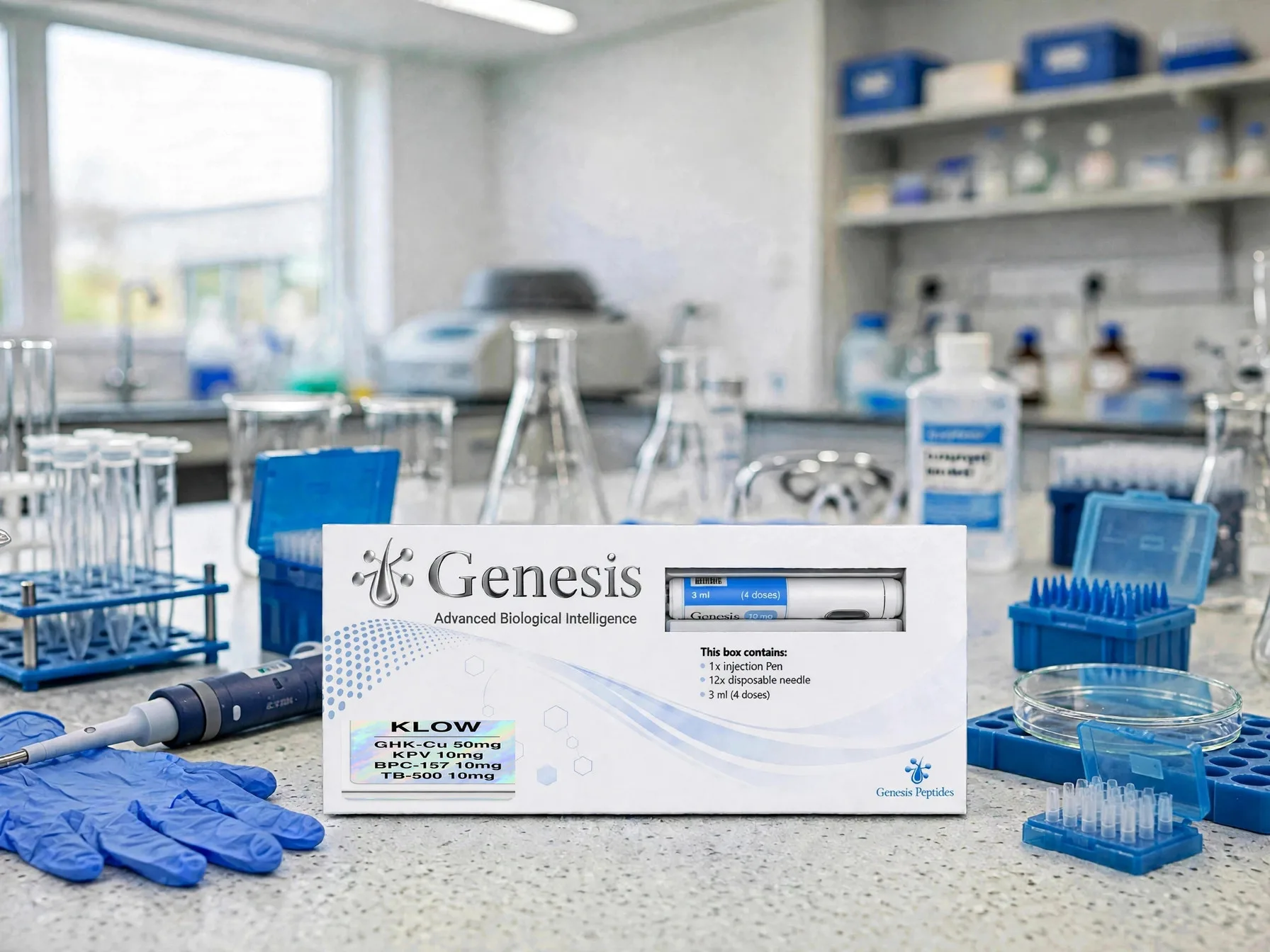
KLOW is a blend of four research peptides that people discuss for repair and recovery and calmer inflammation. Each peptide has been studied on its own We will go through each ingredient and show you what is known and what is only theory.
What Is KLOW Peptide?
KLOW is a four peptide blend. The four ingredients are BPC-157 and TB-500 and GHK-Cu and KPV. A blend or stack means that several compounds are used together because people believe they support each other.
The name makes sense when you see how the stacks grow. BPC-157 and TB-500 together are often called the Wolverine stack. Add GHK-Cu and you get the GLOW stack. Add KPV on top and you get KLOW. Each step adds one more job to the team.
There is no official recipe for KLOW. No health authority has set a standard for it. One seller may mix it differently from another so amounts and purity can vary.
The Four Ingredients in KLOW
BPC-157
BPC-157 is a lab made peptide with 15 amino acids. It is based on a protein first found in stomach fluid. In animal studies it has been linked to new blood vessel growth and to better healing in tendons and the gut. New blood vessel growth is called angiogenesis. Tendons and ligaments have a poor blood supply so they heal slowly and that is why researchers study this area.
The human side is very thin. A review of 36 studies found that 35 were animal or lab studies. The few human reports were small and had no control group.
TB-500
TB-500 is a short lab made piece of a natural protein called thymosin beta 4. The full protein has 43 amino acids. The piece is designed around the part that binds to actin. Actin is a structural protein that lets cells move. The idea is that this helps repair cells travel to an injured spot.
TB-500 is not the same as the full protein. Most of the exciting animal data comes from the full protein. The small piece has far less research and no completed human trials of its own.
GHK-Cu
GHK-Cu is a tiny peptide of three amino acids that binds to copper. In lab studies it can encourage skin cells called fibroblasts to make collagen and elastin. These are the proteins that keep tissue firm and stretchy. Some lab work also points to antioxidant effects and changes in gene activity.
Human data is mostly for creams on the skin. For injected GHK-Cu the evidence is mostly from animals and lab dishes. Ideas such as waking up dormant stem cells or switching off cancer related genes come from early lab work and should be treated as interesting but unproven.
KPV
KPV is another tiny peptide of three amino acids. It is the tail end of a natural hormone called alpha MSH which has anti inflammatory effects. In lab and mouse studies KPV reduced inflammation signals such as NF-kB. Mouse studies of gut inflammation are the best known. Some lab work also reports effects on germs but that is early.
There are no human efficacy trials for KPV. Anything said about it in people is a hope and not a result.
Why Do People Combine These Four?
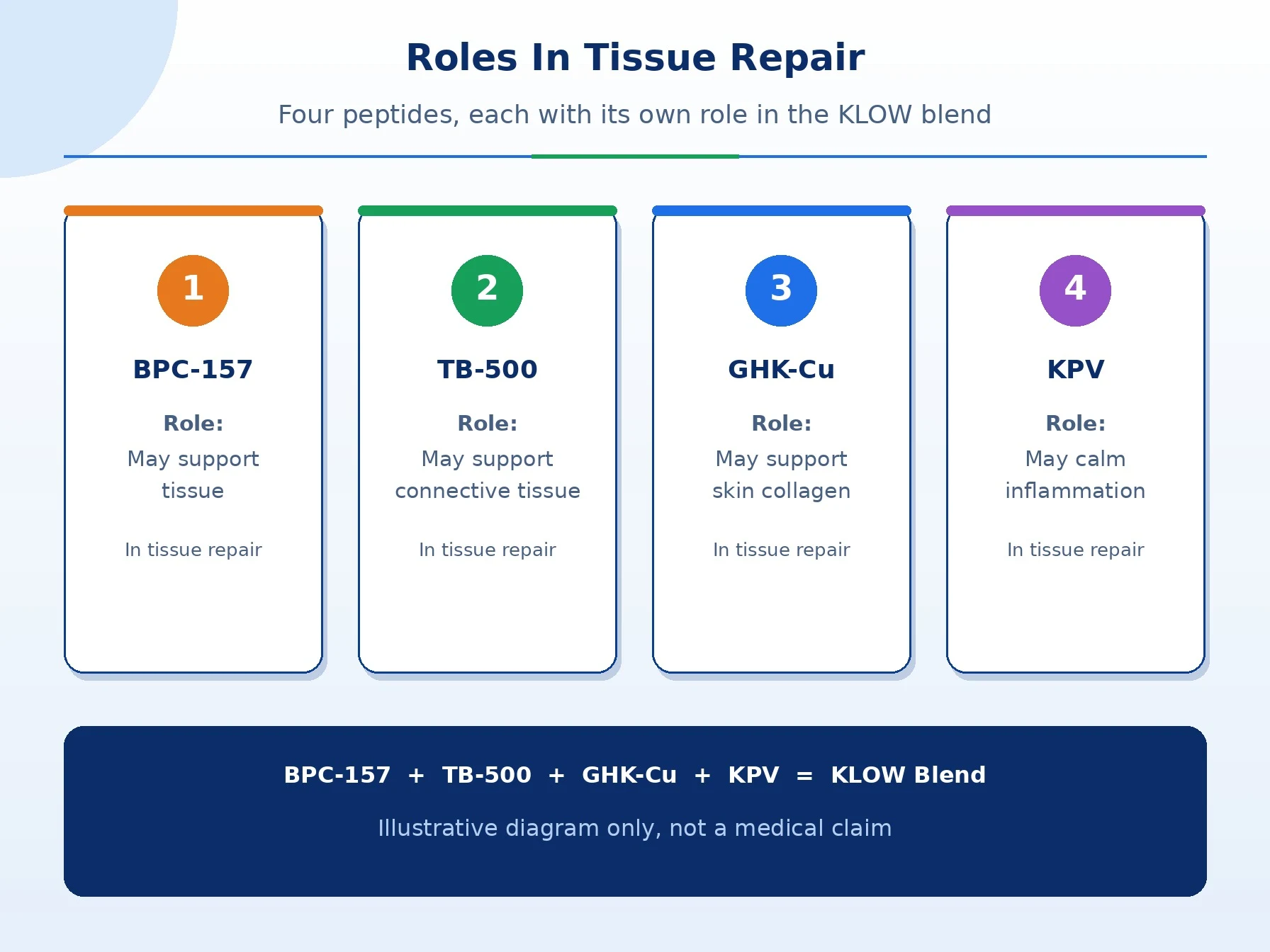
The theory is a full repair team. Picture a building site. BPC-157 helps lay down the roads so supplies can arrive. TB-500 helps send the workers. GHK-Cu helps rebuild the walls and smooth the surface. KPV helps keep the noise and dust down by calming inflammation.
It is a neat story and it is still a story. No study has tested all four together. One recent rat tendon study looked at BPC-157 with TB-500 and reported no extra benefit from combining them. Experts also point out that nobody knows what happens when you push several pathways at once. Cells can have limits on how much signal they can handle and some people worry about the body becoming less responsive. This is a question and not a proven problem.
Do the Four Peptides Stay Stable Together?
This is a common question. Peptides can break down or clump when the liquid around them is too acidic or too alkaline or too warm or handled roughly. GHK-Cu holds on to copper best within a certain acidity range. Small peptides are generally less likely to clump than large ones and all four in KLOW are small.
The practical point is simple. Most stability problems come from how a product is made and stored and not from the idea of mixing small peptides. Good labs check the identity and purity of a peptide with tests such as HPLC and mass spectrometry. We did not find a published study that tests the stability of the full KLOW blend so quality checks matter even more.
What Do People Use KLOW For?
People talk about KLOW for several goals. Here is how each one looks when we check the evidence.
- Tendon and joint recovery. This comes mainly from rodent studies of BPC-157 and TB-500.
- Skin quality. The best human data is for GHK-Cu creams and not for the full blend.
- Calmer inflammation. This is the KPV idea and it rests on lab and mouse work.
- Gut health. BPC-157 and KPV are both studied in animal gut models.
For the blend as a whole there are no human trials. All of these uses are research topics and not proven results.
Side Effects and Safety Points
These are the main points to understand.
- Redness or swelling or bruising or pain at an injection site has been reported with BPC-157.
- Peptides that act on blood vessel pathways may cause dizziness or heart and blood vessel changes.
- Too much copper can be harmful in general and the safety of injected GHK-Cu has not been proven.
- A blend of four makes it hard to tell which one causes a reaction.
There is also a theoretical worry about angiogenesis. New blood vessels can also feed tumours so experts advise extra caution for anyone with cancer or a high risk of it. This is not proven in people and it is a reason to speak with a qualified doctor.
BPC-157 and TB-500 are prohibited at all times in competitive sport by WADA. None of the four is an approved medicine for repair or inflammation. This blog is for education only and is not medical advice.
Why Quality and Sourcing Matter
A blend of four peptides has four chances to go wrong. A product may not match its label or may be contaminated or may contain the wrong fragment. A blend with a blurry label is like a soup with a secret recipe and nobody should have to guess the ingredients.
At Genesis Peptides we supply research peptides in the UK. Our products are for laboratory research use only and not for human consumption. We believe every researcher deserves clear information and honest labelling.
Looking for Research Peptides in the UK?
Genesis Peptides is here to help UK researchers find the right peptides with clear and honest information. Our products are for research use only. Have a question about the peptides in KLOW or any other peptide on our website? Call us or message us on WhatsApp at +44 7343 047659 and our team will be happy to help.
Conclusion
So what does KLOW peptide do? It is a blend of BPC-157 and TB-500 and GHK-Cu and KPV that is built around a repair team idea. Each peptide has an interesting story in the lab.
Read the science with care and choose clear labels over big promises. Genesis Peptides is here to support your research with clear information and honest labelling.
Frequently asked questions
What does KLOW peptide do?
KLOW is a blend of four research peptides that people discuss for repair and recovery and inflammation. Each part has lab or animal research behind it. The full blend has not been tested in people so its real effects are unknown.
What is in the KLOW blend?
KLOW contains BPC-157 and TB-500 and GHK-Cu and KPV. The GLOW blend has the first three and KLOW adds KPV. Some sellers use different versions so always check the label.
What is the difference between GLOW and KLOW?
GLOW has BPC-157 and TB-500 and GHK-Cu. KLOW is the same three plus KPV. The extra peptide is meant to calm inflammation but it is supported only by lab and animal studies.
Has KLOW peptide been tested in humans?
No. No human trial has tested the four peptides together. Human data on single ingredients is limited and KPV has no human efficacy trials.
Is KLOW peptide safe?
Safety has not been established. There are no human safety studies of the blend and long term effects are unknown. Anyone with health questions should speak with a qualified doctor.
Are the peptides in KLOW stable together?
Stability depends mostly on acidity and temperature and handling and quality of the product. All four peptides are small which lowers the clumping risk. We did not find a published stability study of the full blend so clear labels and quality testing matter.