
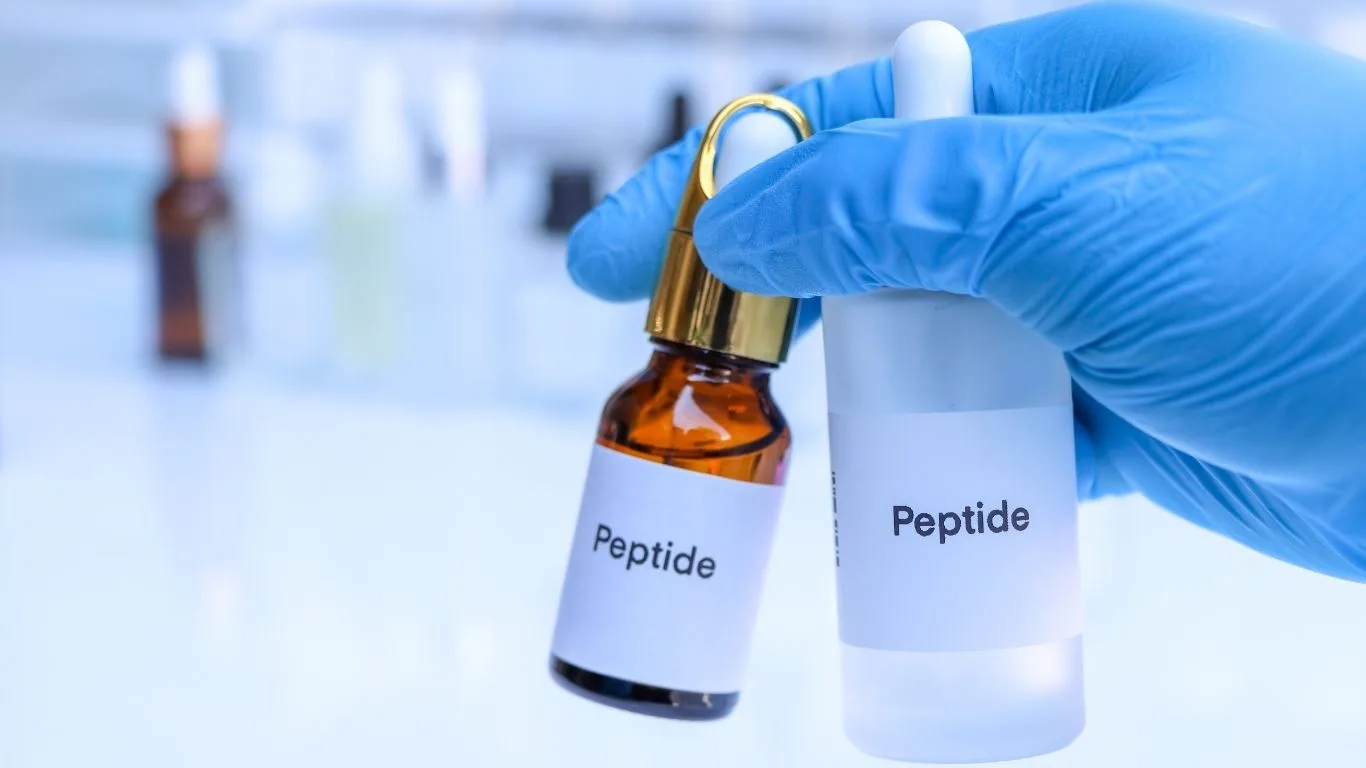
Social media treats BPC-157 like a magic key but so far nobody has shown us the door it opens. Many people ask if it works for injuries and gut problems and if it is safe to take. At Genesis Peptides we believe you deserve clear facts before you make any choice about your health.
This blog follows a talk between two doctors on the show Talking with Docs. They explain what a peptide is and what BPC-157 is. They also explain what the research really shows. We have rewritten their main points in our own words and kept them simple.
The Short Answer
BPC-157 shows interesting results in lab tests and animal studies. But there are no well done human trials that prove it works. The doctors in the talk say the risks are bigger than the proven benefits. They advise people who are using it to stop and people who are thinking about it to avoid it.
What Is a Peptide
A peptide is a small piece of a protein. Proteins are long chains of amino acids and your genes decide the order of those amino acids. A peptide is just a short part of that chain.
There are thousands of different peptides. Some of them are proven and used by doctors every day. Insulin and glucagon and vasopressin are good examples. Collagen peptides are also common in the skin care and wellness market. So peptides as a group are not the problem. Each one needs its own proof.
The peptide market has grown fast in the last five to ten years. BPC-157 became popular in the last five or six years mostly because of social media and wellness centers and the biohacking trend. Many people want an easy way to get a good result without the heavy lifting.
What Is BPC-157 and Where Did It Come From
BPC stands for Body Protection Compound. BPC-157 is a piece of that compound with 15 amino acids. A similar compound is found naturally in the stomach. The idea is that it helps protect the stomach lining from strong acid.
The early research started in the early 1990s in Croatia. Scientists looked at bowel disease and ulcer care. Later the interest moved to tendon and muscle healing. You can read more about our range of research peptides UK on our website.
What Lab and Animal Research Shows
To be fair to BPC-157 the lab results look interesting. Tests outside the body and some animal studies suggest the following.
- It may help repair tissue such as tendons and ligaments and muscle.
- It may support the growth of new blood vessels which healing needs.
- It may lower inflammation.
- It may help move the cells that heal tissue to the right spot.
There is a big catch. A result in a rat does not mean the same result in a person. The doctors point out that you cannot simply carry animal data over to humans. Lab work is a starting point and not a finish line.
What Human Research Shows
The doctors are very direct here. They say there are zero well done human clinical trials that show BPC-157 works. Here is what does exist.
- A phase one trial found no severe harm in the short term. It did not look at long term safety.
- A small knee study with about 12 people. Seven of them said their knee felt better. The doctors call it not a great trial.
- Two registered trials of oral BPC-157 for inflammatory bowel disease. Both are listed without any reported results.
So there is no good human data that says BPC-157 does anything. People who use it today are mostly going on rumors and what friends or videos tell them. If you want to know how research peptides are studied you can read our guide on how peptide research is tested.
Claims vs Evidence Comparison Table
| Common claim | What the evidence shows |
|---|---|
| It heals tendons and ligaments | Seen in lab and animal studies only. No strong human trial. |
| It builds new blood vessels | Seen in lab and animal work. Not proven in people. |
| It lowers inflammation | Seen in animals. Human proof is missing. |
| It is safe | Short term phase one trial showed no severe harm. No long term data. |
| It is approved | Not approved by the FDA or Health Canada or the MHRA for human use. |
| It is allowed in sport | No. The World Anti-Doping Agency bans it. |
| It works for knee pain | One small study of 12 people. Seven felt better. Not a strong trial. |
Why BPC-157 Is Easy to Find Even Though It Is Not Approved
The doctors explain the loophole. A seller can label a product for research purposes only and then sell it. Selling it for use in humans is a different matter and that is illegal. Because of this label sellers can make big claims without having to prove them.
The doctors also warn about product quality. Nobody has to prove how much BPC-157 is really in a vial. This matters a lot for an injectable product. It could be contaminated or not sterile.
In the UK the position is similar. Neither BPC-157 nor TB-500 is approved by the MHRA for human use. You can learn more on our page about peptide laws in the UK.
Safety Concerns Doctors Raise
- Contamination and unsterile products can cause serious infection at the injection site.
- The strength of the product is not checked so the amount inside is unknown.
- BPC-157 may help tissue and blood vessels grow. Uncontrolled growth is also how cancer behaves. This is a theory and not a proven effect but the doctors say it is a fair worry.
- Long term problems may take years to show up. The few studies done have not looked at the long term.
- Athletes risk a ban. The World Anti-Doping Agency lists BPC-157 as a banned substance.
The Placebo Effect and Online Stories
A friend may tell you BPC-157 fixed their shoulder. The doctors remind us that the placebo effect is about 30 percent. That means even a harmless injection can make a person say it helped. On social media the number may be much higher. A plain saltwater injection could earn five stars online.
The doctors also make a simple point. Our bodies are smart and already know how to heal. If a natural compound like this healed tendons by itself researchers could easily test an injured tissue sample to see if it is there. To their knowledge that test has not been done.
Proven Options for Injuries
If you have an injury the doctors say to see your healthcare provider first. They suggest sticking with options that have proof.
- physiotherapy for injury recovery
- Rest and bracing when advised
- Medicine that lowers inflammation when advised
- Platelet rich plasma for some soft tissue injuries since there is growing evidence
There is no free lunch and no shortcut here. You also remain in charge of whatever goes into your body.
Where Genesis Peptides Stands
We are Genesis Peptides and we are open about where we stand. Our products are for research use only. We do not give dosing advice and we do not make human use claims. We do not claim that BPC-157 treats any condition.
We share this information because we want our customers and readers to understand the science and the law. If you want to see our range you can visit our BPC 157 research peptide and TB 500 research peptide pages. If you have a health concern please speak with a doctor or pharmacist.
Get in Touch
Do you have questions about our research peptides or our range at Genesis Peptides? Call or WhatsApp us today on +44 7343 047659 and our team will gladly help.
Conclusion
BPC-157 looks interesting in the lab but interesting is not the same as proven. There are no well done human trials and no long term safety data. It is not approved and it is banned in sport. The doctors say the risks outweigh the proven benefits.
The smart step is to speak with a healthcare professional and choose options with real evidence. At Genesis Peptides we offer research peptides for research use only and we will always share the facts openly.