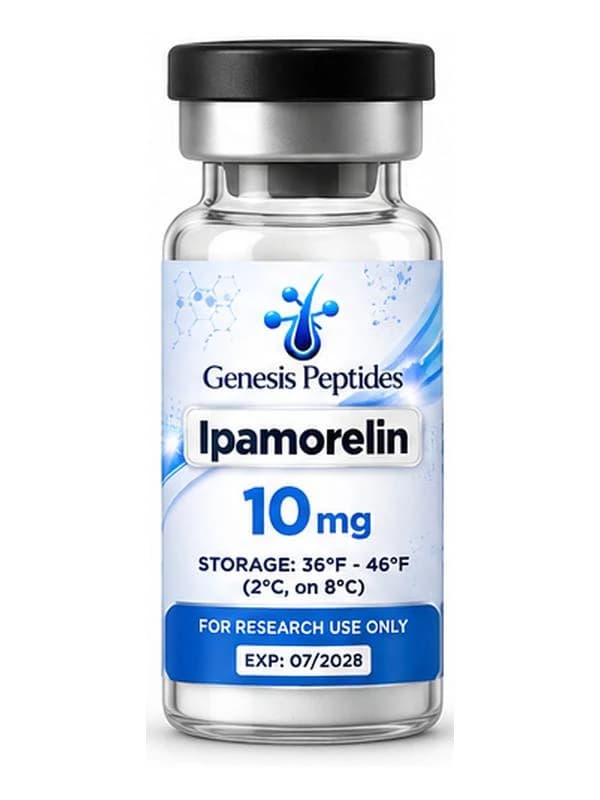
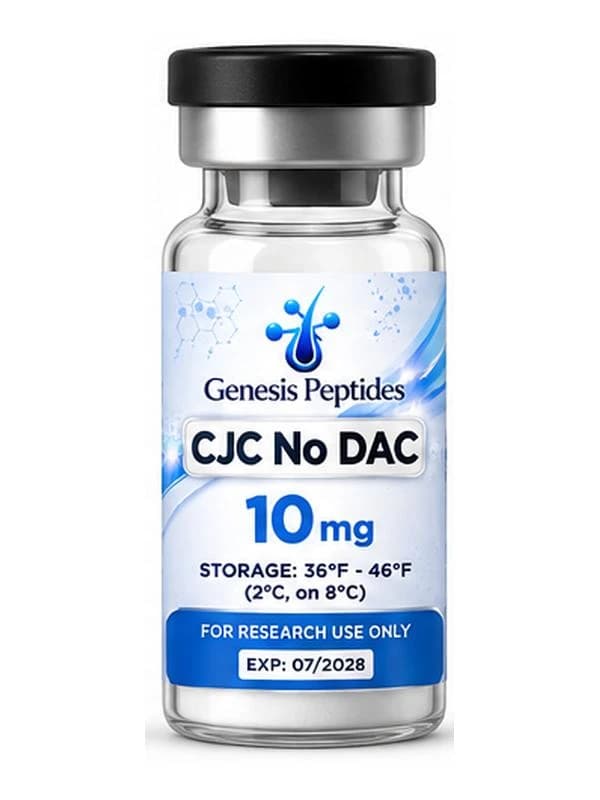
CJC 1295 No DAC 10mg Research Peptide for Laboratory Use
For laboratory research use only. Not for human or veterinary use, not a medicine, food supplement or cosmetic.
- Batch-tested Certificate of analysis for every lot
- Research use only For laboratory research
- UK stock Dispatched from the UK
- Delivery from £6.05 Free over £100.00. Delivery policy
Research PeptidesResearch compound
Genesis Peptide CJC-1295 No DAC 10mg Research Vial
Genesis Peptides supplies CJC 1295 no DAC as a 10mg lyophilised (freeze-dried) research vial, dispatched from the UK.
- HPLC and mass spectrometry
- Research use only
£34.99no VAT charged
In stockUK stock, dispatched from the UK
- Strength
- 10mg
- Product
- CJC 1295 no DAC (Modified GRF (1-29), tetrasubstituted GRF (1-29)), lyophilised powder
- Amount per vial
- 10mg
- Identity
- Mass spectrometry, batch-specific
- Appearance
- White to off-white lyophilised powder
- Storage
- −20 °C for long-term storage, protected from light and moisture
[INSERT MY APPROVED RESEARCH-USE WORDING]
Product Details and Specifications for This Research Peptide
| Product | CJC 1295 no DAC (Modified GRF (1-29), tetrasubstituted GRF (1-29)), lyophilised powder |
|---|---|
| Amount per vial | 10mg |
| Sequence | Tyr-D-Ala-Asp-Ala-Ile-Phe-Thr-Gln-Ser-Tyr-Arg-Lys-Val-Leu-Ala-Gln-Leu-Ser-Ala-Arg-Lys-Leu-Leu-Gln-Asp-Ile-Leu-Ser-Arg-NH2 |
| Length | 29 amino acids, C-terminal amide |
| Molecular formula | C152H252N44O42 |
| Molecular weight | about 3,367.9 g/mol (monoisotopic about 3,365.9) |
| CAS number | [CONFIRM from COA: supplier listings vary] |
| Drug affinity complex (DAC) | None. This is not CJC-1295 with DAC |
| Salt form | [acetate: CONFIRM from COA] |
| Purity (HPLC) | [≥ __% : CONFIRM batch figure] |
| Identity | Mass spectrometry, batch-specific |
| Appearance | White to off-white lyophilised powder |
| Vial | [__ml glass vial, rubber stopper, aluminium crimp cap: CONFIRM] |
| Testing lab | [Lab name, independent or in-house: CONFIRM] |
| Storage | −20 °C for long-term storage, protected from light and moisture |
The vial contains only the peptide as a dry powder, with no water or solvent added. CJC1295 no DAC and the DAC version differ in mass by about 279 g/mol, which is easy to tell apart on a mass spectrum, so the COA confirms that the vial holds CJC 1295 without DAC and not the albumin-binding form. The label carries the batch number, which links to the certificate for that batch.
What Is This Peptide and Why Is It Also Called Modified GRF 1 to 29?
What is CJC 1295? It is a family name for synthetic analogues of growth hormone-releasing hormone, the hypothalamic hormone that signals the pituitary gland to release growth hormone. Natural human GHRH has 44 amino acids, but its first 29 amino acids, GHRH(1-29)-NH2, are enough for full activity at the receptor. That 29-amino-acid fragment is known as GRF (1-29), and its synthetic form was developed as the drug sermorelin.
The problem with GRF (1-29) for research is that it breaks down within minutes in blood. An enzyme called dipeptidyl peptidase-4 (DPP-4) cuts off the first two amino acids, leaving an inactive fragment. To slow this down, researchers swapped four amino acids for more stable ones. The result was named “tetrasubstituted GRF (1-29)” in a 2005 paper by Jetté and colleagues at ConjuChem, and is now usually called Modified GRF (1-29), Mod GRF (1-29), or CJC no DAC.
So what is CJC-1295 in one line? A CJC-1295 GHRH analog: Modified GRF (1-29) is the 29-amino-acid peptide, and CJC-1295 with DAC is the same peptide with an extra chemical group added. When people ask what is CJC peptide, they usually mean one of those two, and the difference between them matters.
What Does No DAC Mean and How Is It Different From the DAC Version?
DAC stands for Drug Affinity Complex. In CJC 1295 with DAC, an extra lysine is added to the end of Modified GRF (1-29), and a maleimidopropionyl group is attached to that lysine. The maleimide reacts with a free cysteine on albumin, the most common protein in blood, so the peptide becomes bonded to albumin and is protected from clearance. That is the original compound ConjuChem named CJC-1295.
Researchers searching CJC 1295 with or without DAC are usually trying to work out which of these two molecules they need. The key differences:
| CJC-1295 no DAC (Mod GRF 1-29) | CJC 1295 DAC | |
|---|---|---|
| Structure | 29 amino acids, four substitutions | Same 29 amino acids plus Lys30 carrying a maleimidopropionyl group |
| Molecular weight | about 3,367.9 g/mol | about 3,647.3 g/mol |
| Albumin binding | No | Yes, covalent, after it enters blood |
| Reported half-life | About 30 minutes is widely quoted (animal and in-vitro data) [VERIFY] | About 6–8 days in healthy adults (Teichman et al., 2006) |
| Signalling pattern in studies | Short pulse of receptor activation | Prolonged activation over days |
The names cause real confusion. Strictly, “CJC-1295” means the DAC compound, and several published papers have wrongly used the name for Modified GRF (1-29). Many suppliers now label the DAC form as CJC-1295 with DAC or CJC-1295 DAC, and the short form as CJC-1295 without DAC. This vial is the no-DAC peptide. If your study design needs the long-acting albumin conjugate, this is not the right product.
Amino Acid Sequence, Molecular Weight and Chemical Structure
CJC 1295 no DAC (29 amino acids, C-terminal amide):
Tyr-D-Ala-Asp-Ala-Ile-Phe-Thr-Gln-Ser-Tyr-Arg-Lys-Val-Leu-Ala-Gln-Leu-Ser-Ala-Arg-Lys-Leu-Leu-Gln-Asp-Ile-Leu-Ser-Arg-NH2
One-letter code: Y-a-DAIFTQSYRKVLAQLSARKLLQDILSR-NH2 (lower-case a = D-alanine)
- Molecular formula: C152H252N44O42
- Molecular weight: about 3,367.9 g/mol (monoisotopic mass about 3,365.9)
- The four substitutions compared with GRF (1-29) / sermorelin:
- Position 2, L-Ala → D-Ala: blocks the DPP-4 cut between amino acids 2 and 3, the main reason natural GRF is inactivated so fast.
- Position 8, Asn → Gln: removes an asparagine that tends to deamidate and rearrange, a known stability weak point [VERIFY].
- Position 15, Gly → Ala: reported in earlier analogue work to support the peptide’s helical shape and its binding to the receptor [VERIFY].
- Position 27, Met → Leu: removes the only methionine, which can oxidise in storage. So this CJC-1295 peptide has no sulphur-containing amino acids.
- Structure: a linear peptide with no disulfide bridges. Like GHRH, it is expected to take a largely helical shape when bound to its receptor. It carries several positive charges (arginine and lysine), which makes it readily soluble in water.
How Is CJC 1295 Studied in Laboratory Research?
CJC 1295 analogues are research tools for the growth hormone axis: the chain from the hypothalamus, through GHRH receptors on the pituitary, to growth hormone release and the hormone IGF-1 made mainly in the liver. Most published research on CJC-1295 uses the DAC version. The findings below come from cell, animal and early human studies. They are not evidence of any benefit or safety in people.
Growth Hormone Releasing Hormone Receptor Research
What does CJC 1295 do at the molecular level? It binds the GHRH receptor (GHRHR), a class B G protein-coupled receptor found mainly on somatotroph cells in the anterior pituitary. Binding activates the Gs protein, raises cyclic AMP inside the cell, and leads to growth hormone release. This is the same receptor used by natural GHRH, sermorelin and tesamorelin, so researchers use these analogues to compare how small changes in sequence affect receptor activation.
In the 2005 study that identified CJC1295, Jetté and colleagues tested a series of GRF (1-29) analogues and albumin conjugates in rats and showed that they activated the GRF receptor on the pituitary (Endocrinology, 2005). In GHRH knockout mice, which cannot make their own GHRH, once-daily CJC-1295 restored normal growth (Alba et al., Am J Physiol Endocrinol Metab, 2006). Because CJC no DAC is short-acting, it is mainly used in research on pulsed, short-term receptor activation rather than the continuous stimulation the DAC version produces.
Peptide Half Life and Stability Research
Stability is the reason Modified GRF (1-29) exists. Natural GHRH and GRF (1-29) are broken down in blood plasma, mainly by DPP-4 cutting off the first two amino acids, to an inactive fragment, with a half-life of under 10 minutes (Frohman et al., J Clin Invest, 1986) [VERIFY]. A study in healthy men showed that swapping position 2 for D-alanine alone increased half-life and reduced clearance of GRF (1-29) (Soule et al., J Clin Endocrinol Metab, 1994) [VERIFY].
Adding the other three changes gives Modified GRF (1-29). A half-life of about 30 minutes is widely quoted for it, based on animal and in-vitro work, but we have not found a published human pharmacokinetic study that measures it directly [VERIFY]. Adding the DAC changes the picture completely: CJC1295 with DAC had an estimated half-life of about 6 to 8 days in healthy adults (Teichman et al., 2006). For lab handling, the practical point is that the dry powder is stable, while the peptide in solution is more vulnerable to breakdown, so storage after reconstitution matters.
What Does Current Evidence Say About Human Studies?
The published human trials of CJC-1295 used the DAC version, and none led to an approved medicine:
- Healthy adults: in two randomised, placebo-controlled studies, single and repeated doses of CJC-1295 with DAC raised growth hormone 2- to 10-fold for six days or more, and IGF-1 1.5- to 3-fold for 9 to 11 days (Teichman et al., J Clin Endocrinol Metab, 2006).
- Growth hormone pattern: a study in healthy men found that the natural pulsing pattern of growth hormone release continued during this stimulation (Ionescu and Frohman, J Clin Endocrinol Metab, 2006).
- Development stopped: ConjuChem took CJC-1295 into phase 2 trials, including in HIV-associated lipodystrophy. In 2006 a trial participant died; the attending doctor judged the death most likely unrelated, but the programme was stopped.
We have not found a published clinical trial of tetrasubstituted GRF (1-29), the CJC 1295 no DAC peptide itself. The D-Ala2 study above tested only one of its four changes. Results from the DAC version or from animals cannot be assumed to apply, so none of the findings on this page should be read as evidence of safety or effect in humans.
CJC 1295 vs Ipamorelin: What Is the Difference in Research?
The two are often discussed together, but they act on different receptors. What is ipamorelin? It is a synthetic five-amino-acid peptide (Aib-His-D-2-Nal-D-Phe-Lys-NH2) that binds the ghrelin receptor, GHS-R1a, not the GHRH receptor. What does ipamorelin do in research? In the 1998 study that introduced it, it released growth hormone in animal models without the rise in ACTH and cortisol seen with older secretagogues such as GHRP-6, which is why it was called “the first selective growth hormone secretagogue” (Raun et al., Eur J Endocrinol, 1998). That paper is the usual starting point for anyone searching ipamorelin PubMed records.
| CJC-1295 no DAC | Ipamorelin | |
|---|---|---|
| Type | GHRH analogue | Ghrelin receptor agonist (GH secretagogue) |
| Receptor | GHRH receptor (GHRHR) | Ghrelin receptor (GHS-R1a) |
| Length | 29 amino acids | 5 amino acids |
| Molecular weight | about 3,367.9 g/mol | about 711.9 g/mol |
| Origin | Modified fragment of natural GHRH | Designed synthetic peptide, from GHRP research |
| WADA status | Prohibited (GHRH analogues) | Prohibited (GH secretagogues) |
The same split answers ipamorelin vs sermorelin: sermorelin is GRF (1-29), the unmodified parent of this peptide, so it works through the GHRH receptor like CJC-1295, while ipamorelin works through the ghrelin receptor. So, whats ipamorelin compared with CJC-1295? A different molecule, on a different receptor, studied for a different part of the same hormone system.
Because GHRH and ghrelin receptors act through separate pathways, some researchers study CJC and ipamorelin together. For a combined CJC 1295 without DAC and ipamorelin product, see our [LINK: CJC-1295 no DAC + Ipamorelin blend, if stocked]. Single vials and blends carry the same research-use-only terms.
Certificate of Analysis and Purity Testing for Each Batch
Every batch of our CJC 1295 no DAC comes with a certificate of analysis (COA) from [CONFIRM: lab name] [independent third-party lab: CONFIRM]. The COA shows two separate tests: HPLC, which measures purity, and mass spectrometry, which confirms the molecule and shows that it is the no-DAC peptide. Both are needed. A high purity figure alone does not prove the main peak is the right peptide, and a correct mass alone does not show how much of the sample is impurity.
How to Find and Download the Certificate for Your Batch
- Find the batch number on your vial label [and on the packing slip: CONFIRM].
- Go to [LINK: COA library page], or use the COA link in the product images on this page.
- Choose the certificate whose batch number matches your vial and download the PDF.
- If you cannot find your batch, contact us at [CONFIRM: email] and we will send it.
A batch-matched COA is the simplest way to judge any CJC 1295 peptide supplier: a certificate that does not match your batch number tells you nothing about what is in your vial.
How to Read HPLC Purity and Mass Spectrometry Results
- HPLC purity: the trace shows one main peak for the peptide and smaller peaks for impurities, such as shortened sequences or sequences with a missing amino acid. Purity is the main peak’s area as a percentage of all peaks. This batch: [CONFIRM: __%].
- Mass spectrometry: the measured mass should match about 3,367.9 (average) or 3,365.9 (monoisotopic). Peptides this size usually appear as several multiply charged ions, for example about 1,123.0 for [M+3H]3+, 842.5 for [M+4H]4+ or 674.2 for [M+5H]5+. A mass of about 3,647 would mean the DAC version, and about 3,358 would suggest unmodified sermorelin, so a clear match confirms you have CJC-1295 no DAC.
- Net peptide content (if shown): the share of the powder that is peptide, as opposed to counter-ions (usually acetate) and residual water. It is usually below 100% even when purity is high.
- Check the details: the product name, batch number, test date and lab name should all be on the certificate.
How to Store and Handle a Lyophilised Peptide Vial
Freeze-dried CJC no DAC is much more stable as a dry powder than in solution. For long-term storage, keep the sealed vial at −20 °C, away from light and moisture. For short periods, 2–8 °C in a fridge is generally suitable for lyophilised peptides [CONFIRM in-house guidance]. Before opening a cold vial, let it reach room temperature so moisture from the air does not condense on the powder. Handle with gloves, using sterile technique, in a lab setting. Like other CJC peptides, it has no methionine or cysteine, so oxidation is less of a concern than for many peptides, but breakdown in solution still limits how long it keeps once mixed.
Storage Before and After Reconstitution
- Before reconstitution: sealed vial at −20 °C long term, or 2–8 °C short term. Unopened shelf life: [__ months: CONFIRM].
- Reconstitution: in research protocols, the powder is usually dissolved in sterile bacteriostatic water [LINK: bac water], added slowly down the side of the vial and swirled gently rather than shaken.
- After reconstitution: store the CJC 1295 no DAC solution at 2–8 °C, protected from light, and use within [__ days/weeks: CONFIRM from your stability data]. Avoid repeated freezing and thawing; if longer storage is needed, split the solution into single-use aliquots and freeze them.
- Discard any solution that turns cloudy, changes colour or contains particles.
Is Research Use of This Peptide Legal in the UK, and Is It Banned in Sport?
[LEGAL REVIEW: this section]
- Not a licensed medicine. CJC 1295, with or without DAC, has no marketing authorisation from the MHRA, so it cannot legally be sold or supplied in the UK as a medicine for human use. Genesis Peptides sells CJC-1295 UK stock only as a research chemical for laboratory use.
- Not a controlled drug. CJC-1295 is not listed under the Misuse of Drugs Act 1971 [VERIFY].
- Not approved anywhere. CJC-1295 has not been approved as a medicine in any country. Its development stopped at phase 2 in 2006.
- Banned in sport. Yes. The World Anti-Doping Agency (WADA) 2026 Prohibited List names CJC-1295 under S2 peptide hormones, in the growth hormone releasing factors category (“GHRH and its analogues”, alongside sermorelin and tesamorelin). It is prohibited at all times, in and out of competition, and UK Anti-Doping (UKAD) applies the same list. Ipamorelin is also prohibited, as a growth hormone secretagogue.
We will not sell to anyone who says they intend to use the product on a person or an animal.
What to Check Before Buying Research Peptides in the UK
If you plan to buy CJC 1295, the right product is the one whose quality and identity you can check, not the cheapest. Before you buy CJC 1295 no DAC from any supplier, check:
- Which molecule it is. The listing and COA should say clearly whether it is Modified GRF (1-29) without DAC or CJC-1295 with DAC. A listing that just says “CJC-1295” is ambiguous.
- A batch-matched COA with both HPLC purity and mass spectrometry identity, from a named lab.
- Net peptide content and salt form, so you know how much actual peptide is in the vial.
- Clear research-use labelling and no dosing, injection or health claims. A supplier that gives human dosing advice is selling outside the rules.
- A UK address and contact details, and dispatch from the UK.
- Correct format: lyophilised powder in a sealed vial. Oral, tablet or capsule “CJC” products are not the same thing; peptides of this size are broken down in the gut.
Many searches for peptide CJC 1295 lead to marketplaces and resellers that cannot show a batch certificate. To order from Genesis, add the 10mg vial to your basket at the top of this page.
UK Delivery, Dispatch and Packaging
- Dispatch: orders placed before [CONFIRM: time] on a working day are dispatched the same day from [CONFIRM: town/county].
- Delivery: [CONFIRM: carrier and service, e.g. Royal Mail Tracked 24], [CONFIRM: price / free over £__].
- Packaging: vials are sealed and packed in [CONFIRM: protective packaging details], in plain outer packaging. Lyophilised peptides are stable at room temperature for the length of normal UK transit; store them as described above on arrival [CONFIRM].
- Payment: [CONFIRM: payment methods].
When you order CJC 1295 UK stock from us, each order includes the batch number for COA lookup. For larger CJC-1295 UK orders for a lab, contact [CONFIRM: email].
Scientific References and Published Studies
Key published studies on GRF (1-29) analogues, CJC-1295 and ipamorelin cited on this page:
- Frohman LA, Downs TR, Williams TC, Heimer EP, Pan YC, Felix AM. Rapid enzymatic degradation of growth hormone-releasing hormone by plasma in vitro and in vivo to a biologically inactive product cleaved at the NH2 terminus. J Clin Invest. 1986;78(4):906–913. [VERIFY]
- Soule S, King JA, Millar RP. Incorporation of D-Ala2 in growth hormone-releasing hormone-(1-29)-NH2 increases the half-life and decreases metabolic clearance in normal men. J Clin Endocrinol Metab. 1994;79(4):1208–1211. [VERIFY]
- Raun K, Hansen BS, Johansen NL, et al. Ipamorelin, the first selective growth hormone secretagogue. Eur J Endocrinol. 1998;139(5):552–561.
- Jetté L, Léger R, Thibaudeau K, et al. Human growth hormone-releasing factor (hGRF)1-29-albumin bioconjugates activate the GRF receptor on the anterior pituitary in rats: identification of CJC-1295 as a long-lasting GRF analog. Endocrinology. 2005;146(7):3052–3058.
- Teichman SL, Neale A, Lawrence B, Gagnon C, Castaigne JP, Frohman LA. Prolonged stimulation of growth hormone (GH) and insulin-like growth factor I secretion by CJC-1295, a long-acting analog of GH-releasing hormone, in healthy adults. J Clin Endocrinol Metab. 2006;91(3):799–805.
- Ionescu M, Frohman LA. Pulsatile secretion of growth hormone (GH) persists during continuous stimulation by CJC-1295, a long-acting GH-releasing hormone analog. J Clin Endocrinol Metab. 2006;91(12):4792–4797.
- Alba M, Fintini D, Sagazio A, et al. Once-daily administration of CJC-1295, a long-acting growth hormone-releasing hormone (GHRH) analog, normalizes growth in the GHRH knockout mouse. Am J Physiol Endocrinol Metab. 2006;291(6):E1290–E1294.
- World Anti-Doping Agency. Prohibited List 2026, S2 Peptide Hormones, Growth Factors, Related Substances and Mimetics: growth hormone releasing factors.
[CHECK: add DOI or PubMed links before publishing]
Related Research Peptides and Buying Guides
If you are working with CJC 1295 no DAC, these related CJC peptides, GHRH-axis research products and supplies may also be useful:
- Tesamorelin Research Pen: another GHRH analogue, full 44-amino-acid GHRH with a modified N-terminus, acting on the same receptor. [LINK: Tesamorelin pen]
- CJC-1295 no DAC + Ipamorelin blend: GHRH and ghrelin receptor peptides in one vial. [LINK: blend page, if stocked]
- Ipamorelin: the ghrelin receptor peptide compared above. [LINK: Ipamorelin vial, if stocked]
- Bacteriostatic water 10ml: for reconstituting lyophilised peptides in research protocols. [LINK: Bac water]
- Guides: [LINK: How to read a peptide COA] · [LINK: How to store research peptides]
All products are for laboratory research use only. Not for human or veterinary use.
FAQ
Frequently Asked Questions
Quick answers on batch testing, delivery and ordering. Can’t find what you need? Our team is happy to help.
Contact UsWhat is inside a CJC 1295 vial?
Only lyophilised peptide powder: 10mg of Modified GRF (1-29), the CJC 1295 no DAC peptide, as its [CONFIRM: acetate] salt, with no water, solvent or other active ingredients. The exact purity and net peptide content of each vial are on the batch COA.
Is it the same as the version with DAC?
No. CJC 1295 with DAC is the same 29-amino-acid peptide plus an extra lysine carrying a maleimide group that bonds to albumin in blood. That raises its reported half-life from minutes to about 6–8 days. This vial has no DAC, and the mass spectrometry result on the COA (about 3,368 rather than about 3,647) confirms it.
Are there any human studies on this peptide?
Not on the no-DAC peptide itself, as far as we can find. Published human trials used CJC-1295 with DAC, in healthy adults in 2006, and its phase 2 programme stopped that year. A 1994 study in healthy men tested only the D-Ala2 change. No version has been approved as a medicine.
Is it legal to buy in the UK?
Buying CJC-1295 UK stock as a research chemical for laboratory use is lawful [LEGAL REVIEW]. It is not a licensed medicine and must not be sold or used as one. It is banned in sport at all times under WADA’s list of GHRH analogues.
Is this product third party tested?
Yes. Every batch of this CJC 1295 peptide is tested by [CONFIRM: lab name] [CONFIRM independent] for HPLC purity and mass spectrometry identity, and the batch certificate is available to download.
How long can it be stored once reconstituted?
Keep reconstituted CJC-1295 no DAC at 2–8 °C, away from light, and use it within [__ days/weeks: CONFIRM]. For longer storage, freeze single-use aliquots and avoid repeated freeze-thaw cycles. Unopened lyophilised vials last much longer at −20 °C.
Calculator
Peptide Reconstitution Calculator
Enter the amount in the vial, the volume of diluent added and the amount you need. The calculator works out the concentration and the volume to measure.
- Volume to measure
- 0.05 ml
- 50 µl
- Concentration
- 5,000 mcg/ml
- 5 mg/ml
- Portions per vial
- 40
- at 250 mcg each