Copper is usually found in pennies and pipes so it is fair to wonder how it ended up in skincare research. GHK-Cu is a small peptide that carries a copper ion and it is studied for skin repair and collagen and hair.
GHK-Cu is sold today as a research peptide in many places. The lab results are interesting. The human evidence is still limited and this is especially true for injections. We will keep every claim in this guide tied to what research actually shows.
What Is GHK-Cu Peptide?
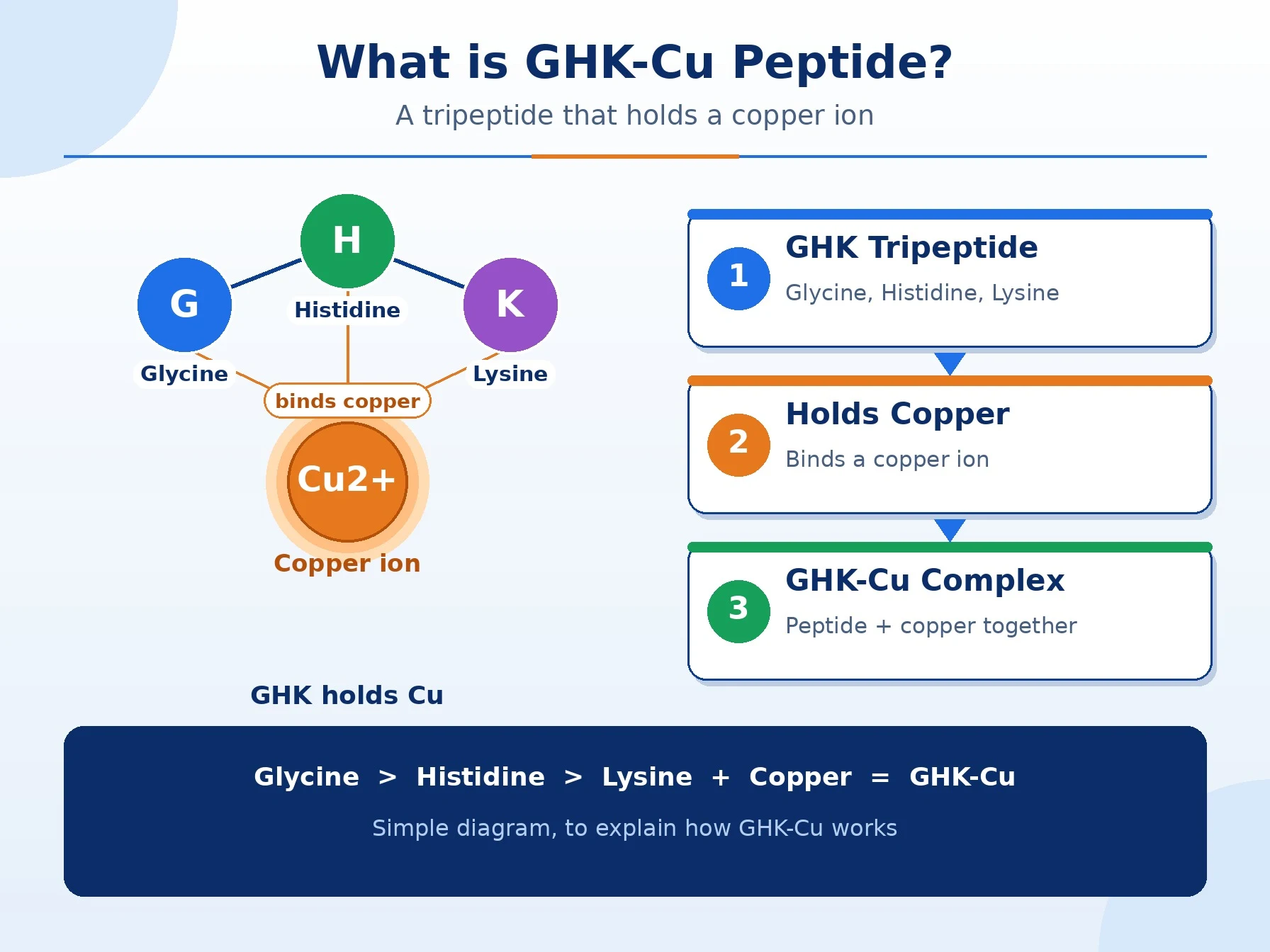
GHK is a tripeptide. That means it is made of three amino acids. They are glycine and histidine and lysine. The name GHK comes from the first letter of each one.
GHK-Cu is the form of GHK that is bound to copper. The peptide acts like a carrier that holds the copper ion. Researchers first found GHK in human blood plasma in the 1970s.
GHK also occurs naturally in the body. This is one reason scientists find it interesting. It is not a strange foreign molecule. It is a small signal the body already knows.
How Does GHK-Cu Work?
Most of what we know about how GHK-Cu works comes from cell and animal studies. Here are the main ideas that researchers describe.
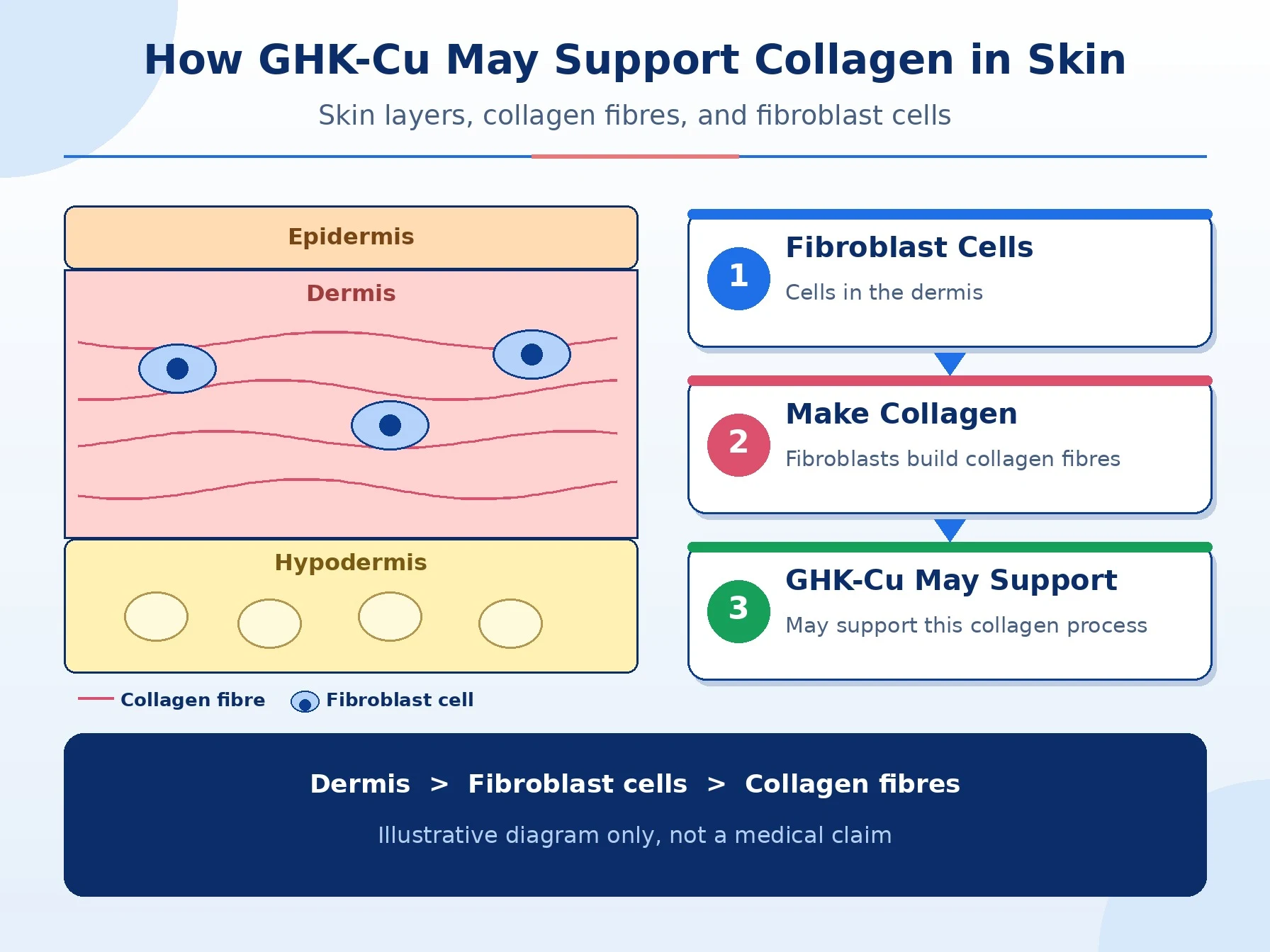
- It may help skin cells called fibroblasts make more collagen and elastin and other support proteins.
- It may encourage the growth of new blood vessels which is called angiogenesis.
- It may act as an antioxidant and calm oxidative stress in cells.
- It may lower some inflammation signals such as TNF alpha and IL 6 in animal studies.
- It may block an enzyme called elastase that breaks down elastin.
In lab studies on human skin cells GHK-Cu raised collagen and elastin production. That is a real and useful finding. It is still a result from cells in a dish and it does not prove the same effect in a living person.
GHK-Cu and Ageing
You will often read that GHK levels in the blood fall as we get older. A commonly quoted figure is about 200 ng/mL around age 20 and about 80 ng/mL by age 60. This idea explains why GHK-Cu is linked with loose skin and fine lines and thinner hair.
This link is a theory. A drop in a natural molecule with age does not prove that adding it back will reverse ageing. Researchers still need strong human trials to answer that question.
GHK-Cu Benefits and Uses in Research
When people ask about the benefits and uses of GHK-Cu they usually mean the areas where it is studied. Each area has a different level of evidence.
Skin and Collagen
This is the best known area. Cell studies show more collagen and elastin. GHK-Cu has also been studied in skin care products at very low concentrations. Reviews note that there are only limited human clinical trials of GHK-Cu itself.
Wound Healing
Many wound studies were done in rodents. Some of them used GHK mixed with other materials such as hydrogels and not GHK-Cu alone. Clinics sometimes talk about GHK-Cu for slow healing wounds. That is not the same as proof from large human trials.
Hair
Some clinics include GHK-Cu in scalp protocols. Researchers link it with skin and follicle support. Strong human trials for hair growth with injected GHK-Cu are still missing so results should not be promised.
Use Alongside Other Procedures
Some clinics describe using GHK-Cu next to procedures such as micro needling. These are clinic reports. They are not controlled studies and they do not show that GHK-Cu improves the result.
GHK-Cu Evidence at a Glance
| Area | What research found | Strength of evidence |
|---|---|---|
| Collagen and elastin in skin cells | More collagen and elastin made in human skin cell studies | Lab only |
| Antioxidant and inflammation effects | Lower stress and inflammation signals in cells and animals | Lab and animal only |
| Wound healing | Positive results in mostly rodent studies | Animal with limited human data |
| Skin ageing in people | Limited clinical trials of GHK-Cu itself | Limited |
| Hair growth with injections | Clinic use but no strong trials | Not established |
| Long term injection safety | No large human safety studies | Unknown |
Topical vs Injectable GHK-Cu
GHK-Cu comes in creams and serums and also as a research peptide for injection. The two are very different when it comes to evidence.
Topical GHK-Cu has been used in cosmetic products for years. A safety review judged GHK safe for cosmetic use at a very low maximum concentration. The challenge is absorption. Reviews note that GHK-Cu does not enter the skin easily and that it breaks down or clears quickly from the body.
Injected GHK-Cu is a newer trend. Some clinics promote it as more effective. The science has not caught up. Large human trials of injected GHK-Cu are missing and long term safety is not known. Media reports in 2026 even described the shift from creams to injections as running ahead of the science.
For this reason this guide does not give dosing or injection advice. Anyone who is curious should talk with a qualified doctor.
*\[Image Placeholder showing a comparison of a topical serum bottle and a sealed research vial. Alt text topical vs injectable GHK-Cu\]*
GHK-Cu Side Effects and Safety
Nobody can give a complete safety answer yet. Here is what is reasonable to know.
- Skin products can cause redness or itching in some people.
- Injected peptides can cause redness or swelling or itching at the injection site.
- Any peptide can trigger an allergic reaction in rare cases. Stop right away if hives or swelling appear.
- Contaminated or mislabelled products add extra risk.
- Long term effects of injected GHK-Cu have not been studied well.
GHK-Cu also contains copper. Anyone with a condition that affects how the body handles copper should speak with a doctor first.
You may read that GHK-Cu is extremely safe. That claim goes further than the data. Safe use in a cosmetic cream at low concentration is not the same as proof of safety for injections.
This blog is for education only and is not medical advice. Always speak with a qualified doctor about your own health.
Why Quality and Sourcing Matter
Because the evidence is still growing the quality of the material matters even more. A vial that hides its contents is like a mystery box and nobody wants a mystery in the lab. Peptides from unclear sources can be mislabelled or contaminated and that makes any result hard to trust.
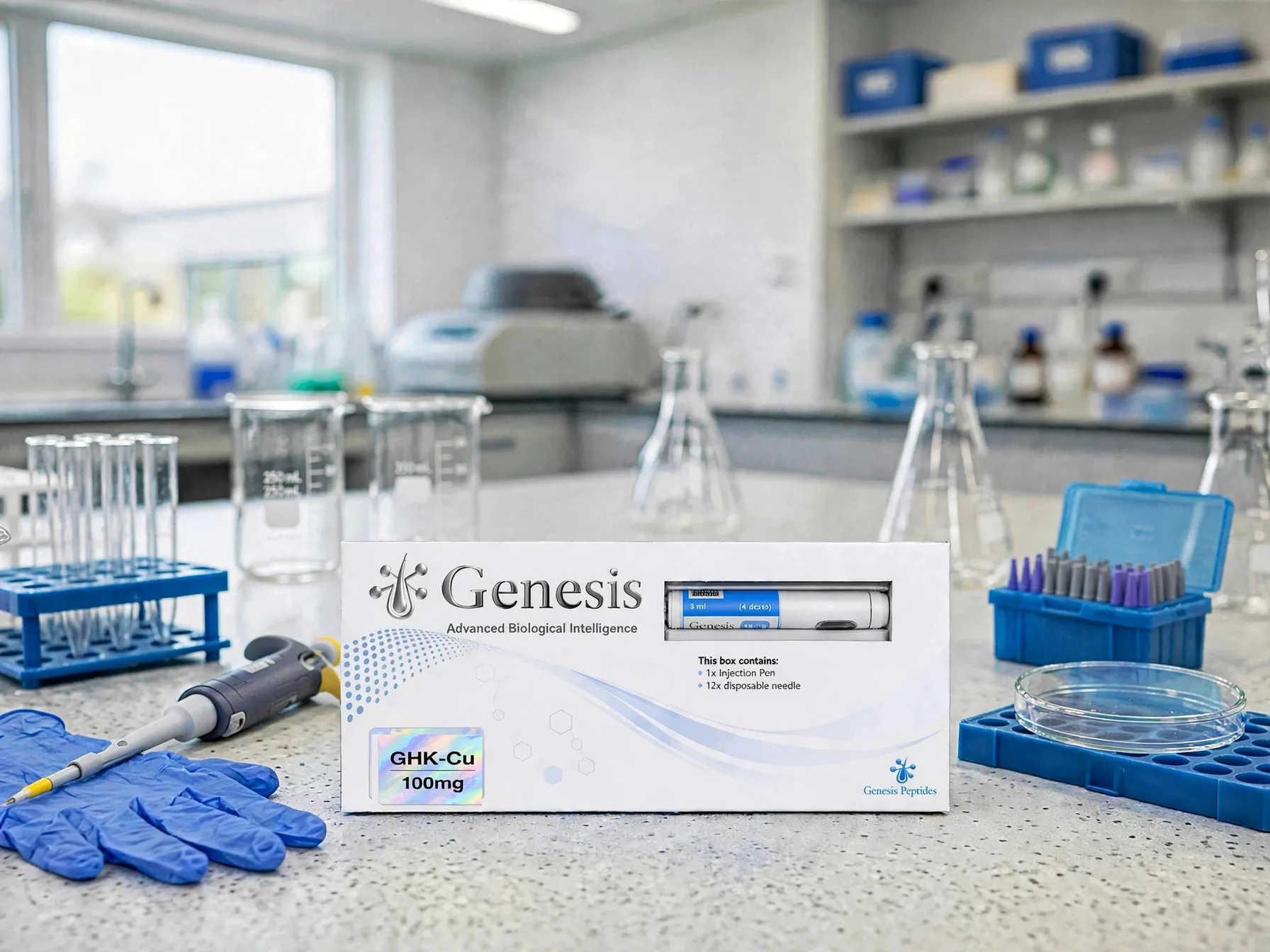
At Genesis Peptides we supply research peptides in the UK. Our products are for laboratory research use only and not for human consumption. We believe every researcher deserves clear information and honest labelling.
Looking for Research Peptides in the UK?
Genesis Peptides is here to help UK researchers find the right peptides with clear and honest information. Our products are for research use only. Have a question about GHK-Cu or any other peptide on our website? Call us or message us on WhatsApp at +44 7343 047659 and our team will be happy to help.
Conclusion
So what is GHK-Cu peptide and how does it work? It is a small copper carrying peptide that the body makes naturally. Lab studies show it may boost collagen and calm stress in cells. Human evidence is still limited and strong trials of injected GHK-Cu are missing.
The honest summary is that GHK-Cu is a promising research topic and not a proven ageing treatment. Keep your expectations realistic and always choose a source you can trust. Genesis Peptides is here to support your research with clear information and honest labelling.
REFERENCE: https\://www.youtube.com/watch?v=c6yULazFb-8\&pp=ygU7R0hLLUN1IFBlcHRpZGU6IEJlbmVmaXRzLCBVc2VzLCBTaWRlIEVmZmVjdHMgJiBIb3cgSXQgV29ya3M%3D
Frequently asked questions
What is GHK-Cu peptide?
GHK-Cu is a small peptide made of three amino acids and bound to a copper ion. It occurs naturally in the body and was first found in human blood plasma in the 1970s. Today it is studied for skin repair and collagen and it is sold as a research peptide.
What does GHK-Cu do?
In lab studies GHK-Cu raised collagen and elastin production in human skin cells and showed antioxidant and anti inflammatory effects. Animal studies also point to faster wound healing. Large human trials are still missing so these effects are not proven in people.
Does GHK-Cu help with hair loss?
It is not proven. Some clinics include GHK-Cu in scalp protocols and researchers link it with skin and follicle support. Strong human trials for hair growth with injected GHK-Cu are missing. Results should never be promised.
Is GHK-Cu better as a cream or an injection?
Nobody can say that yet. Creams have a longer record in cosmetics but absorption is a challenge. Injections are a newer trend with no large human trials and unknown long term safety. A qualified doctor is the right person to ask.
What are the side effects of GHK-Cu?
Reported effects are usually local such as redness or itching or swelling at the site. Rare allergic reactions are possible with any peptide. Long term effects of injections are unknown. Stop right away if hives or swelling appear and speak with a doctor.
Does GHK-Cu really decline with age?
Researchers report that GHK levels in the blood fall with age. A commonly quoted figure is about 200 ng/mL at age 20 and about 80 ng/mL by age 60. Whether adding it back changes how we age has not been proven in strong human trials.
Is GHK-Cu approved as a medicine?
No. Injected GHK-Cu is not approved as a medicine and it is sold as a research peptide. Low concentrations are used in some cosmetic products. Anyone with health questions should speak with a qualified doctor.